Sidecar Pattern
Learn the Sidecar Pattern for distributed systems — deploy companion containers alongside application services to handle cross-cutting concerns like.
Quick answer: Sidecar Pattern
Sidecar Pattern is covered here as a practical system design concept. Learn the Sidecar Pattern for distributed systems — deploy companion containers alongside application services to handle cross-cutting concerns like. Use it to understand the Distributed Systems idea, where it appears in production systems, and how to discuss it clearly in interviews.
Focus on the problem being solved, the main design choice, the failure mode, and the tradeoff you would defend in front of a senior engineer. This page is part of the DosiBridge system design knowledge graph, so it links related concepts, interview problems, tradeoffs, and references instead of leaving the topic isolated.
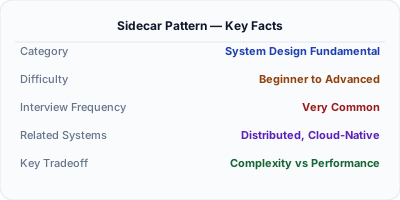
The Sidecar Pattern deploys a companion process or container alongside every application instance to handle cross-cutting concerns — logging, monitoring, networking, security — without modifying the application itself. Just as a motorcycle sidecar extends functionality without changing the motorcycle, a sidecar container extends a service with capabilities like TLS termination, log forwarding, or health checking. In Kubernetes, sidecar containers share a pod with the main application, accessing the same network namespace and local storage. This pattern is the foundation of service meshes and modern cloud-native architectures.
| Aspect | Details |
|---|---|
| What it is | A companion container or process deployed alongside every service instance to handle cross-cutting operational concerns transparently |
| When to use | When multiple services written in different languages need consistent logging, monitoring, TLS, or proxy behavior without duplicating code in each |
| When NOT to use | When the cross-cutting concern is language-specific or tightly coupled to business logic, making a separate process impractical or inefficient |
| Real-world example | Envoy sidecar proxies are used in Istio, AWS App Mesh, and Google Cloud service mesh to handle networking for millions of production pods |
| Interview tip | Explain how sidecars enable polyglot architectures — the same sidecar handles TLS for Java, Go, and Python services identically |
| Common mistake | Overusing sidecars for every concern — each sidecar adds memory, CPU, and startup latency overhead; consolidate related concerns into fewer sidecars |
| Key tradeoff | Transparency vs. resource cost — sidecars decouple concerns cleanly but multiply resource usage by running an additional process per service instance |
Why This Matters
In a microservices architecture, cross-cutting concerns like TLS termination, structured logging, metrics collection, and circuit breaking must be implemented consistently across every service. If services are written in Java, Go, Python, and Node.js, implementing these in each language means maintaining four separate libraries, each potentially inconsistent. The Sidecar Pattern solves this by extracting these concerns into a separate process that runs alongside every service. The application communicates with the sidecar via localhost, and the sidecar handles external communication. This provides language-agnostic consistency, independent deployability (update the sidecar without redeploying the application), and clean separation of concerns between business logic and operational infrastructure.
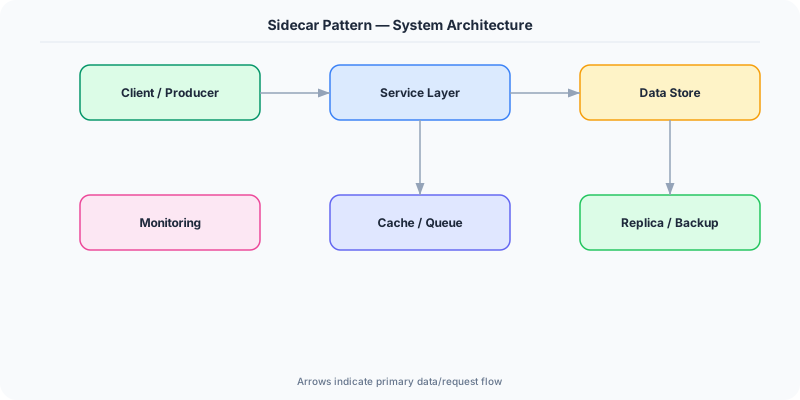
The Building Blocks
- Sidecar Container: A separate container within the same pod (Kubernetes) or process group that shares network and storage with the primary application container
- Localhost Communication: The application and sidecar communicate via localhost or shared volumes, avoiding network latency and simplifying security since traffic never leaves the pod
- Lifecycle Management: The sidecar starts before and stops after the main container, ensuring that operational capabilities are available throughout the application's lifecycle
- Transparent Interception: The sidecar intercepts traffic using iptables rules or port binding so the application is unaware of the sidecar's presence — no code changes required
- Independent Deployment: Sidecars can be upgraded independently of the application, allowing platform teams to roll out security patches or feature updates without application team involvement
Under the Hood
The Sidecar Pattern is implemented primarily in container orchestration platforms like Kubernetes. A pod definition includes two or more containers: the primary application container and one or more sidecar containers. All containers in a pod share the same network namespace (they see the same localhost), the same IP address, and can mount shared volumes for file-based communication.
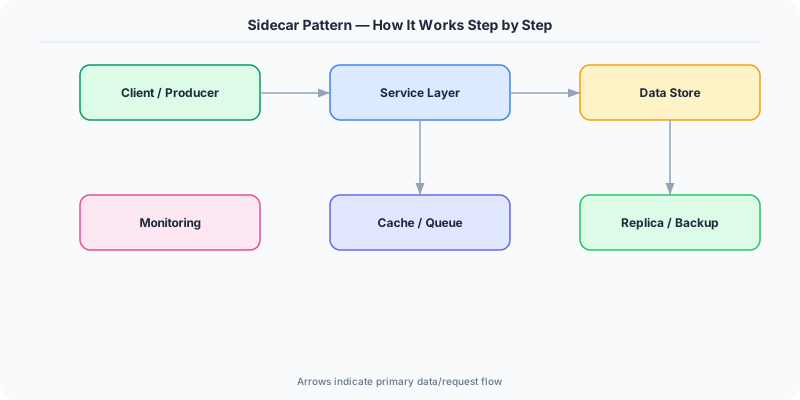
In the Envoy sidecar model, init containers configure iptables rules that redirect all inbound and outbound pod traffic through the Envoy proxy on specific ports. The application listens on its normal port (e.g., 8080), but external traffic hits the Envoy sidecar first. Envoy handles TLS termination, applies retry policies, emits metrics, and forwards the request to localhost:8080. Outbound traffic follows the reverse path — the application connects to a remote service, but iptables redirects the connection through Envoy, which applies routing rules and circuit breaking.
Kubernetes 1.28 introduced native sidecar support via the restartPolicy: Always field on init containers. This ensures sidecars start before and terminate after the main container, solving the longstanding problem of race conditions where the main container starts before the sidecar proxy is ready, or the sidecar terminates before the main container finishes draining connections. For resource management, sidecars should have their own CPU and memory requests/limits separate from the application to prevent resource contention.
How Companies Actually Do This
Google Uses Envoy sidecar proxies across their cloud platform, with GKE's Traffic Director configuring millions of sidecar instances for service-to-service communication
Datadog Deploys their monitoring agent as a sidecar container alongside customer applications in Kubernetes, collecting metrics, traces, and logs without requiring any application code changes
HashiCorp Consul Connect uses Envoy sidecar proxies for service mesh connectivity, providing mTLS and authorization between services across Kubernetes and VM-based infrastructure
Common Pitfalls
- Not accounting for sidecar startup ordering — the application may start making requests before the sidecar proxy is ready, causing connection failures during pod initialization
- Running too many sidecars per pod — each sidecar adds memory overhead (50-200MB typically), and three sidecars in every pod can double overall cluster resource consumption
- Debugging failures through sidecars is harder — when a request fails, you must determine whether the failure is in the application, the sidecar, or the interaction between them
Interview Questions Worth Practicing
- How does the Sidecar Pattern enable polyglot microservices architectures to maintain consistent cross-cutting behavior?
- What are the resource and complexity implications of deploying sidecar containers alongside every application pod?
- How does Kubernetes native sidecar support (1.28+) improve upon the previous workaround patterns for sidecar lifecycle management?
The Tradeoffs
- Decoupling vs. Overhead: Sidecars cleanly separate concerns and enable independent deployment but add memory, CPU, and latency overhead per instance
- Consistency vs. Flexibility: A standard sidecar ensures uniform behavior across all services but may not accommodate service-specific customization needs
- Transparency vs. Debuggability: Transparent traffic interception requires no code changes but makes it harder to understand and debug the complete request path
How to Explain This in an Interview
Here is how I would explain Sidecar Pattern in a system design interview:
The Sidecar Pattern deploys a companion container alongside each application instance to handle cross-cutting concerns — TLS, logging, metrics, circuit breaking — without modifying the application. In Kubernetes, both containers share a pod, communicating via localhost with near-zero latency. This is the foundation of service meshes: Envoy sidecars intercept all traffic transparently via iptables rules, handling retries and mTLS without application code changes. The key benefit is polyglot consistency — the same sidecar serves Java, Go, and Python services identically. The main tradeoff is resource overhead: each sidecar consumes 50-200MB RAM. Kubernetes 1.28 native sidecar support solved the critical startup-ordering problem where applications launched before their sidecars were ready.
Related Topics
Original DosiBridge notes for Sidecar Pattern
This section is written specifically for this page, not copied from a general system-design checklist. The useful way to study Sidecar Pattern is to connect the concept to a production service where growth exposes the first weak assumption in the original design. That framing changes the design discussion from definitions to operating choices.
What makes this topic distinct
- Membership: For Sidecar Pattern, decide the membership before choosing tools; otherwise the design looks clean but fails when sidecar changes.
- Clock Drift: For Sidecar Pattern, decide the clock drift before choosing tools; otherwise the design looks clean but fails when pattern changes.
- Retry Semantics: For Sidecar Pattern, decide the retry semantics before choosing tools; otherwise the design looks clean but fails when sidecar changes.
- Partition Behavior: For Sidecar Pattern, decide the partition behavior before choosing tools; otherwise the design looks clean but fails when pattern changes.
- Reconciliation: For Sidecar Pattern, decide the reconciliation before choosing tools; otherwise the design looks clean but fails when sidecar changes.
Production review question
If a team adopts Sidecar Pattern, what observable signal proves it helped instead of only making the architecture diagram more fashionable?
Practical metric to track
Track sidecar-pattern health as a named dashboard or review item: combine one user-facing metric, one saturation metric, and one correctness metric. For Sidecar Pattern, this keeps the discussion grounded in behavior that can be measured after deployment instead of generic advice that sounds good in an interview but never gets verified.