Service Mesh
Learn Service Mesh architecture with Istio, Linkerd, and sidecar proxies — handle service-to-service communication, security, observability, and traffic.
Quick answer: Service Mesh
Service Mesh is covered here as a practical system design concept. Learn Service Mesh architecture with Istio, Linkerd, and sidecar proxies — handle service-to-service communication, security, observability, and traffic. Use it to understand the Distributed Systems idea, where it appears in production systems, and how to discuss it clearly in interviews.
Focus on the problem being solved, the main design choice, the failure mode, and the tradeoff you would defend in front of a senior engineer. This page is part of the DosiBridge system design knowledge graph, so it links related concepts, interview problems, tradeoffs, and references instead of leaving the topic isolated.
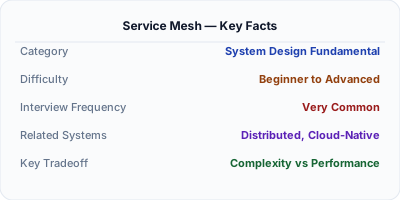
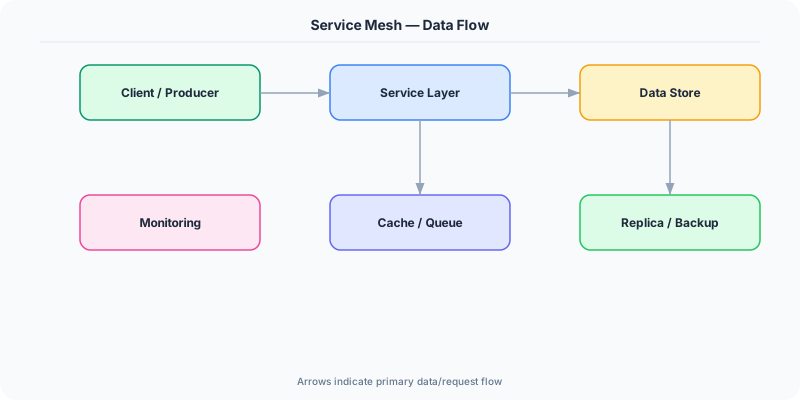
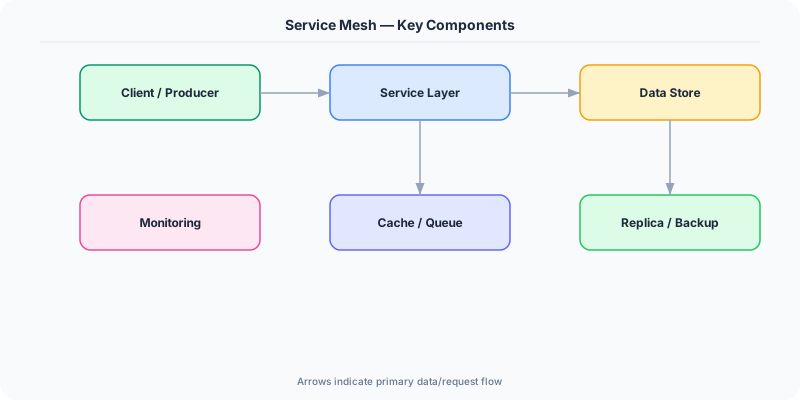
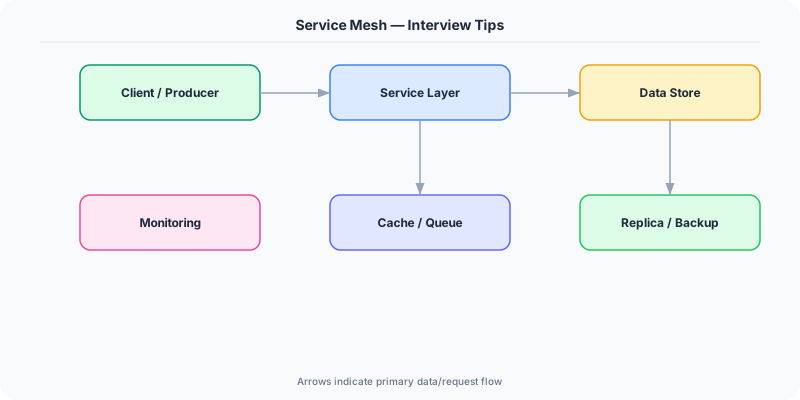
A service mesh is a dedicated infrastructure layer that handles service-to-service communication in a microservices architecture. Instead of each service implementing its own retry logic, circuit breaking, TLS, and tracing, a sidecar proxy (like Envoy) is deployed alongside every service instance and transparently intercepts all network traffic. The control plane (Istio, Linkerd) configures these proxies centrally, providing uniform security (mutual TLS), observability (automatic metrics and traces), and traffic management (canary deployments, fault injection) without changing application code.
| Aspect | Details |
|---|---|
| What it is | A dedicated infrastructure layer of sidecar proxies that transparently handles service-to-service communication, security, and observability |
| When to use | When operating 20+ microservices where implementing consistent retry, TLS, tracing, and traffic routing in every service is unsustainable |
| When NOT to use | When you have fewer than 10 services and the operational complexity of running a mesh exceeds the communication complexity it solves |
| Real-world example | Lyft created Envoy proxy to handle cross-cutting communication concerns across their microservices fleet, which became the foundation for Istio |
| Interview tip | Explain the data plane (sidecar proxies) vs. control plane (Istio/Linkerd) architecture and why this separation matters |
| Common mistake | Adopting a service mesh for a small number of services — the operational overhead of running Istio outweighs benefits for fewer than 15-20 services |
| Key tradeoff | Transparency vs. complexity — the mesh removes communication logic from services but adds significant infrastructure complexity and resource overhead |
Why This Matters
As microservices architectures grow, every service needs retry logic, circuit breaking, mutual TLS, distributed tracing, and traffic routing. Implementing these in every service — often written in different languages by different teams — leads to inconsistency, bugs, and duplication. A service mesh moves these cross-cutting concerns into the infrastructure layer. Each service gets a sidecar proxy that intercepts all inbound and outbound traffic. The proxy handles retries, timeouts, circuit breaking, mTLS encryption, and telemetry emission without the application knowing. The control plane provides centralized configuration, certificate management, and traffic policies. This separation means teams focus on business logic while the platform team manages communication infrastructure uniformly across all services.
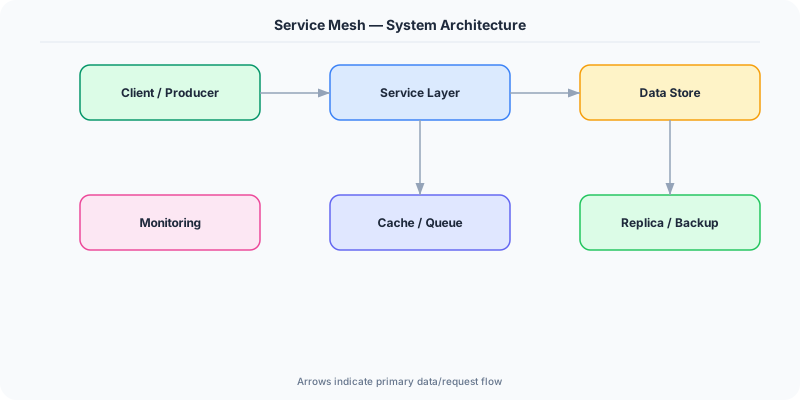
The Building Blocks
- Data Plane: The fleet of sidecar proxies (Envoy, Linkerd-proxy) deployed alongside every service instance, handling all actual network traffic between services
- Control Plane: The management layer (Istio's istiod, Linkerd's control plane) that configures proxy behavior, distributes certificates, and manages traffic policies
- Mutual TLS: Automatic encryption and authentication between all services — each proxy has a certificate, and the mesh verifies identity on every connection without application code changes
- Traffic Management: Fine-grained control over request routing — canary deployments sending 5% of traffic to a new version, A/B testing, traffic mirroring for shadow testing
- Observability Integration: Automatic generation of metrics (request rate, error rate, latency), distributed traces, and access logs for every service call without instrumentation code
Under the Hood
A service mesh consists of two planes. The data plane is a network of lightweight proxies deployed as sidecar containers alongside every application pod. In Kubernetes, a mutating admission webhook automatically injects the sidecar proxy into every pod. All inbound and outbound traffic is redirected through the proxy using iptables rules, making the interception transparent to the application.
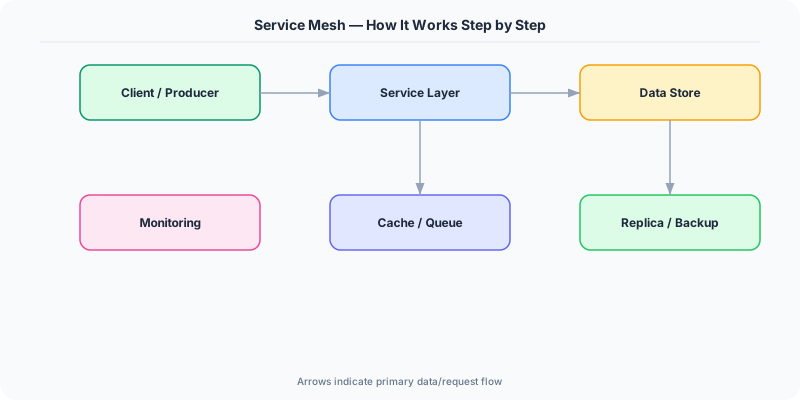
The control plane manages proxy configuration and certificate distribution. Istio's istiod component watches Kubernetes for service changes, compiles routing rules and security policies, and pushes xDS (discovery service) configuration updates to all Envoy proxies. It also runs a certificate authority that issues short-lived mTLS certificates to every proxy, rotated automatically. This means every service-to-service call is encrypted and mutually authenticated without any application code changes.
Traffic management is the most powerful service mesh capability. Virtual services define routing rules: send requests with header canary:true to version v2, mirror 1% of production traffic to a shadow environment, inject 500ms latency into 5% of requests to test resilience. Destination rules configure load balancing algorithms, connection pool sizes, and outlier detection per service. The challenge is operational complexity — running Istio adds 100-200MB of memory per sidecar proxy, increases tail latency by 1-3ms per hop, and requires a dedicated platform team for upgrades and troubleshooting.
How Companies Actually Do This
Lyft Created Envoy proxy to solve cross-cutting service communication challenges, which became the standard sidecar proxy used in Istio, AWS App Mesh, and most service mesh implementations
Airbnb Adopted Istio to enforce mutual TLS between all services, automatically encrypting service-to-service traffic and eliminating an entire class of internal network security vulnerabilities
Shopify Uses a service mesh to manage traffic routing during deployments, enabling canary releases that gradually shift traffic to new versions with automatic rollback on error rate increases
Common Pitfalls
- Adopting a full service mesh (Istio) when simpler alternatives suffice — a lightweight library-based approach may work better for smaller fleets with a single programming language
- Underestimating resource overhead — Envoy sidecars consume 100-200MB RAM per pod and add 1-3ms P99 latency per hop, which compounds in deep call chains
- Not investing in mesh observability — when the mesh itself has issues (misconfigured routes, certificate expiry), debugging requires understanding the mesh's own telemetry and configuration
Interview Questions Worth Practicing
- What is the difference between the data plane and control plane in a service mesh?
- When would you recommend adopting a service mesh versus using a library-based approach for service communication?
- How does mutual TLS in a service mesh work, and why is it better than application-level TLS?
The Tradeoffs
- Transparency vs. Overhead: The mesh removes communication logic from applications but adds latency, memory, and operational complexity per service instance
- Consistency vs. Flexibility: Uniform policies across all services reduce bugs but may be too restrictive for services with unique communication requirements
- Istio vs. Linkerd: Istio is feature-rich but complex and resource-heavy; Linkerd is simpler, lighter, and faster but has fewer traffic management features
How to Explain This in an Interview
Here is how I would explain Service Mesh in a system design interview:
A service mesh is a dedicated infrastructure layer for handling service-to-service communication. It consists of a data plane — sidecar proxies like Envoy deployed alongside every service — and a control plane like Istio that configures them centrally. The mesh transparently handles retries, circuit breaking, mutual TLS, traffic routing, and observability without application code changes. Key capabilities include automatic mTLS encryption between all services, canary deployment traffic splitting, and uniform metrics collection. I would recommend a service mesh when operating 20+ microservices where consistent cross-cutting concerns become unsustainable. The main tradeoff is transparency versus overhead — each sidecar adds memory and latency, and the mesh itself requires operational expertise.
Related Topics
Original DosiBridge notes for Service Mesh
This section is written specifically for this page, not copied from a general system-design checklist. The useful way to study Service Mesh is to connect the concept to a production service where growth exposes the first weak assumption in the original design. That framing changes the design discussion from definitions to operating choices.
What makes this topic distinct
- Membership: For Service Mesh, decide the membership before choosing tools; otherwise the design looks clean but fails when service changes.
- Clock Drift: For Service Mesh, decide the clock drift before choosing tools; otherwise the design looks clean but fails when mesh changes.
- Retry Semantics: For Service Mesh, decide the retry semantics before choosing tools; otherwise the design looks clean but fails when service changes.
- Partition Behavior: For Service Mesh, decide the partition behavior before choosing tools; otherwise the design looks clean but fails when mesh changes.
- Reconciliation: For Service Mesh, decide the reconciliation before choosing tools; otherwise the design looks clean but fails when service changes.
Production review question
If a team adopts Service Mesh, what observable signal proves it helped instead of only making the architecture diagram more fashionable?
Practical metric to track
Track service-mesh health as a named dashboard or review item: combine one user-facing metric, one saturation metric, and one correctness metric. For Service Mesh, this keeps the discussion grounded in behavior that can be measured after deployment instead of generic advice that sounds good in an interview but never gets verified.