Serverless Architecture: Functions, Cold Starts and Scaling Tradeoffs
Learn serverless architecture for system design: FaaS, cold starts, event triggers, scaling limits, state management, observability, and cost tradeoffs.
Quick answer: Serverless Architecture: Functions, Cold Starts and Scaling Tradeoffs
Serverless Architecture: Functions, Cold Starts and Scaling Tradeoffs is covered here as a practical system design concept. Learn serverless architecture for system design: FaaS, cold starts, event triggers, scaling limits, state management, observability, and cost tradeoffs. Use it to understand the Architecture Patterns idea, where it appears in production systems, and how to discuss it clearly in interviews.
Focus on the problem being solved, the main design choice, the failure mode, and the tradeoff you would defend in front of a senior engineer. This page is part of the DosiBridge system design knowledge graph, so it links related concepts, interview problems, tradeoffs, and references instead of leaving the topic isolated.
What Serverless Architecture Actually Means
Serverless architecture runs code without managing servers. You write functions; the cloud provider handles provisioning, scaling, and infrastructure. You pay only for actual compute time. AWS Lambda, Google Cloud Functions, and Cloudflare Workers are examples.
When to Use It (and When Not To)
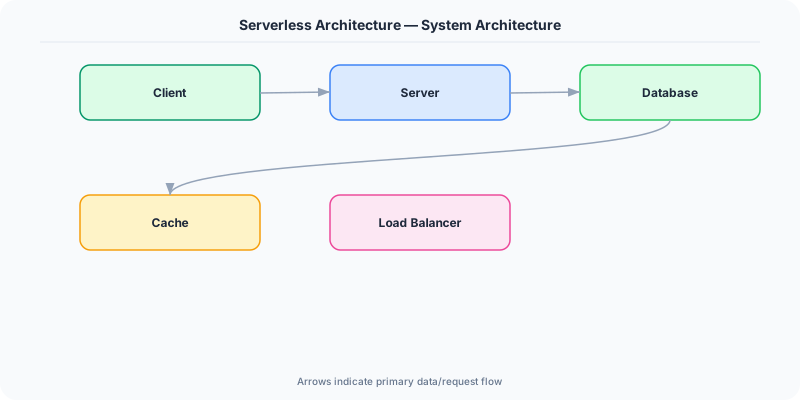
Serverless eliminates operational overhead for many use cases. There are no servers to patch, no capacity to plan, and no idle resources to pay for. It is ideal for event-driven workloads, APIs, and background processing.
The Architecture
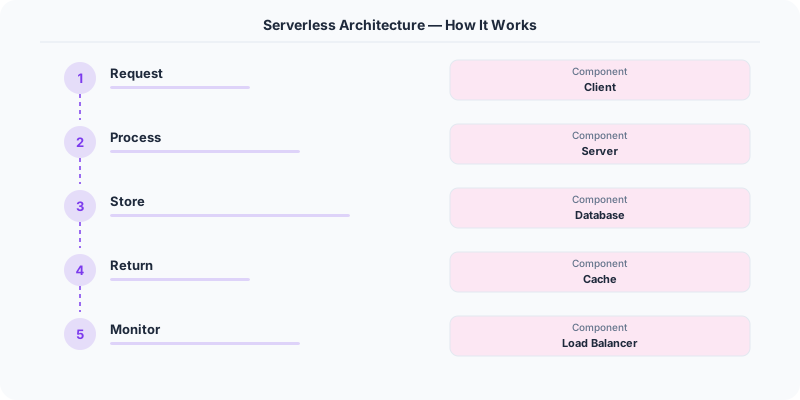
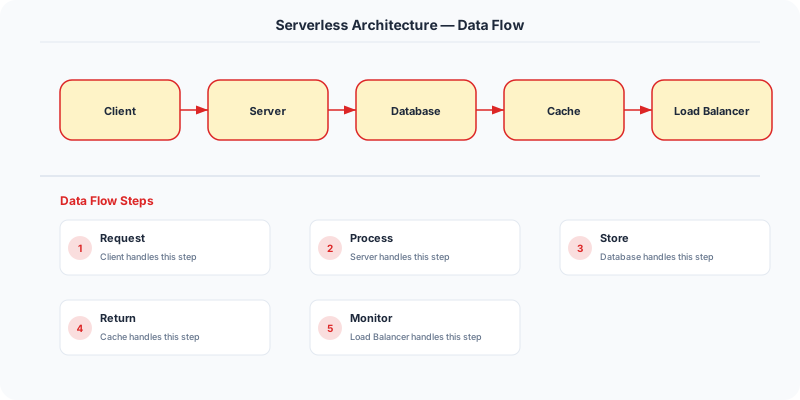
You write a function (e.g., processOrder in Node.js) and deploy to AWS Lambda. You configure a trigger (API Gateway for HTTP, SQS for queue messages). When a request arrives, Lambda allocates a container, loads your function, executes it, and returns the result. If 1000 requests arrive simultaneously, Lambda spins up 1000 containers.
After 15 minutes of no traffic, containers are destroyed. You pay nothing until the next request.
Key Principles
- Functions as a Service (FaaS): Write individual functions that are triggered by events (HTTP requests, queue messages, file uploads).
- Auto-scaling: The platform scales from zero to thousands of instances automatically based on demand.
- Pay-per-use: Charged per invocation and compute time. Zero traffic = zero cost.
- Stateless: Functions are ephemeral — each invocation starts fresh. Use external storage (DynamoDB, S3) for state.
- Cold starts: The first invocation after idle time takes longer (100ms-10s) because the platform must initialize the runtime.
Who Does This Well
Coca-Cola uses AWS Lambda for their vending machine backend — processing payments and inventory updates.
iRobot (Roomba) uses Lambda to process robot telemetry data from millions of devices.
Figma uses Cloudflare Workers for edge API processing, reducing latency for global users.
The Hard Parts Nobody Talks About
- Using serverless for long-running jobs — use containers or VMs instead
- Not accounting for cold start latency in latency-sensitive applications
- Vendor lock-in — deeply integrating with one provider's serverless ecosystem
The Tradeoffs
- No servers to manage vs Less control: You cannot tune OS settings, install custom runtimes, or control placement.
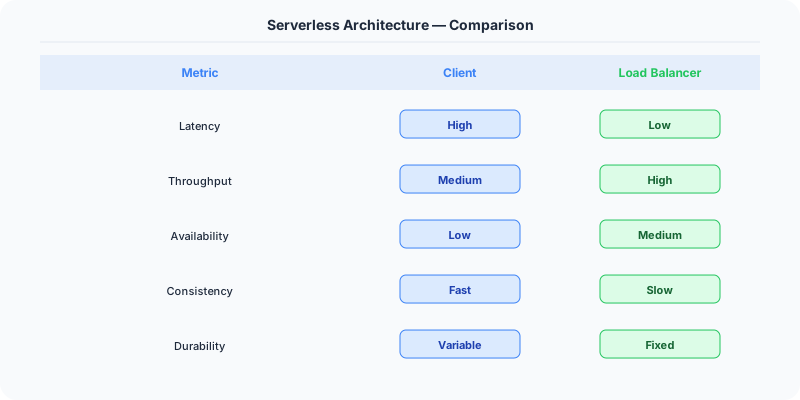
- Cost at scale: Serverless is cheap at low volume but can be expensive at high volume (compared to reserved instances).
- Cold starts: First request after idle is slow. Mitigate with provisioned concurrency (pre-warmed containers).
- Execution limits: Lambda has a 15-minute timeout, 10GB memory limit, and 6MB response size limit.
Interview Angles
- When is serverless appropriate?
- What are cold starts and how do you mitigate them?
- What are the limitations of serverless?
- How does serverless handle state?
Keep Learning
Original DosiBridge notes for Serverless Architecture: Functions, Cold Starts and Scaling Tradeoffs
This section is written specifically for this page, not copied from a general system-design checklist. The useful way to study Serverless Architecture: Functions, Cold Starts and Scaling Tradeoffs is to connect the concept to a production service where growth exposes the first weak assumption in the original design. That framing changes the design discussion from definitions to operating choices.
What makes this topic distinct
- Ownership Boundary: For Serverless Architecture: Functions, Cold Starts and Scaling Tradeoffs, decide the ownership boundary before choosing tools; otherwise the design looks clean but fails when serverless changes.
- Blast Radius: For Serverless Architecture: Functions, Cold Starts and Scaling Tradeoffs, decide the blast radius before choosing tools; otherwise the design looks clean but fails when serverless changes.
- Deployment Path: For Serverless Architecture: Functions, Cold Starts and Scaling Tradeoffs, decide the deployment path before choosing tools; otherwise the design looks clean but fails when serverless changes.
- Runtime Coupling: For Serverless Architecture: Functions, Cold Starts and Scaling Tradeoffs, decide the runtime coupling before choosing tools; otherwise the design looks clean but fails when serverless changes.
- Operational Handoff: For Serverless Architecture: Functions, Cold Starts and Scaling Tradeoffs, decide the operational handoff before choosing tools; otherwise the design looks clean but fails when serverless changes.
Production review question
If a team adopts Serverless Architecture: Functions, Cold Starts and Scaling Tradeoffs, what observable signal proves it helped instead of only making the architecture diagram more fashionable?
Practical metric to track
Track serverless health as a named dashboard or review item: combine one user-facing metric, one saturation metric, and one correctness metric. For Serverless Architecture: Functions, Cold Starts and Scaling Tradeoffs, this keeps the discussion grounded in behavior that can be measured after deployment instead of generic advice that sounds good in an interview but never gets verified.