Event-Driven Architecture: Events, Brokers and Loose Coupling
Master event-driven architecture: producers, consumers, brokers, event schemas, ordering, idempotency, outbox pattern, and microservice tradeoffs.
Quick answer: Event-Driven Architecture: Events, Brokers and Loose Coupling
Event-Driven Architecture: Events, Brokers and Loose Coupling is covered here as a practical system design concept. Master event-driven architecture: producers, consumers, brokers, event schemas, ordering, idempotency, outbox pattern, and microservice tradeoffs. Use it to understand the Architecture Patterns idea, where it appears in production systems, and how to discuss it clearly in interviews.
Focus on the problem being solved, the main design choice, the failure mode, and the tradeoff you would defend in front of a senior engineer. This page is part of the DosiBridge system design knowledge graph, so it links related concepts, interview problems, tradeoffs, and references instead of leaving the topic isolated.
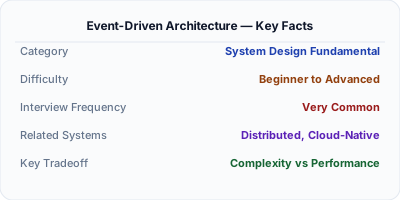
What Event-Driven Architecture Actually Means
Event-driven architecture (EDA) is a design pattern where the flow of the program is determined by events — significant changes in state. Components produce events (order placed, payment received), and other components consume them asynchronously. This decouples producers from consumers and enables reactive, scalable systems.
When to Use It (and When Not To)
EDA enables loose coupling, scalability, and real-time processing. It is the architecture behind real-time analytics, IoT systems, and modern microservices platforms. In interviews, understanding EDA shows you can design beyond simple request-response systems.
The Architecture
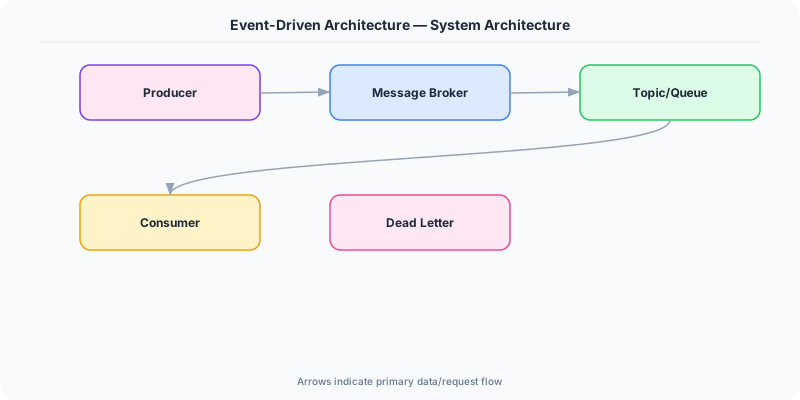
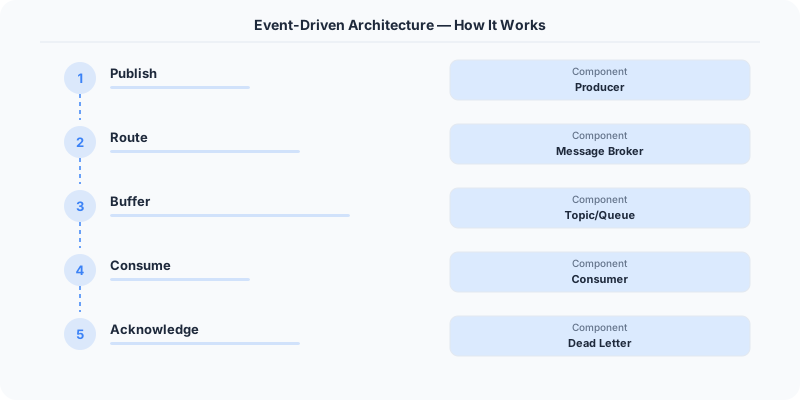
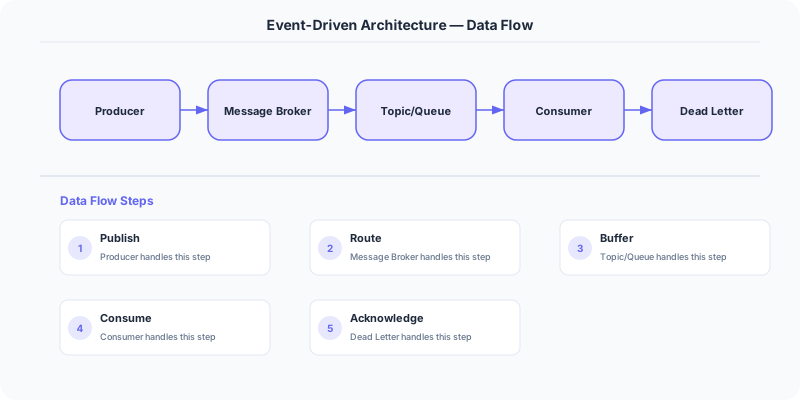
When a user places an order: the Order Service publishes an 'OrderPlaced' event to Kafka. The Payment Service consumes the event and charges the customer. The Inventory Service consumes it and reserves items. The Notification Service sends a confirmation email. Each service processes independently and at its own pace.
If the Payment Service is temporarily down, events queue up in Kafka and are processed when it recovers. No data is lost.
Key Principles
- Events: Immutable records of something that happened. 'OrderPlaced', 'PaymentFailed', 'UserRegistered'.
- Producers and Consumers: Producers emit events; consumers react to them. They do not know about each other.
- Event broker: A middleware (Kafka, RabbitMQ, AWS EventBridge) that stores and routes events between producers and consumers.
- Event sourcing: Store all changes as a sequence of events. Rebuild state by replaying events. Used by banking systems.
- CQRS: Command Query Responsibility Segregation — separate the write model (commands) from the read model (queries). Often paired with event sourcing.
Who Does This Well
LinkedIn processes billions of events per day through Kafka for activity feeds, recommendations, and analytics.
Uber uses an event-driven architecture for ride matching, pricing, and driver dispatch.
Netflix uses event-driven patterns for content recommendation, A/B testing, and user activity tracking.
The Hard Parts Nobody Talks About
- Not versioning events — schema changes break consumers
- Not handling out-of-order events — network delays can deliver events in wrong order
- Over-using events for everything — simple synchronous calls are sometimes better
The Tradeoffs
- Decoupling vs Debugging: EDA decouples services but makes it harder to trace the flow of a request.
- Eventual consistency: Events are processed asynchronously, so the system is eventually consistent — not immediately.
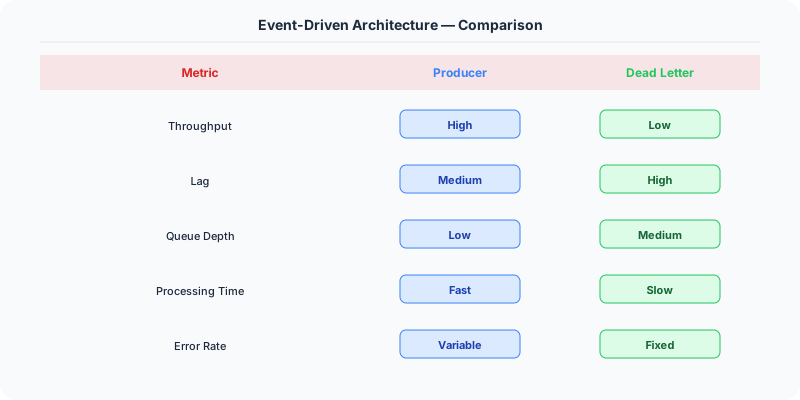
- Complexity: Event schemas, ordering, deduplication, and dead letter queues all add complexity.
Interview Angles
- What is event-driven architecture?
- What is the difference between event-driven and request-driven architecture?
- What is event sourcing?
- What is CQRS?
Keep Learning
Production angle: event-driven architecture that actually survives retries
The practical version of event-driven architecture is not simply "publish an event and let another service react". In production the hard part is deciding what the event means, who owns the state change, and how the system behaves when messages arrive twice, arrive late, or arrive in a different order than expected.
A good event-driven design starts with business facts rather than technical notifications. 'OrderPlaced', 'PaymentAuthorized', and 'RideCompleted' are stronger events than 'OrderUpdated' because consumers can reason about them without calling the producer to guess what changed. The producer owns the fact; consumers own their reaction.
Design decisions that make this page different
- Event contract: define the event name, version, required fields, optional fields, and backward-compatibility rules before picking Kafka, RabbitMQ, SNS, or Pub/Sub.
- Write path: use the transactional outbox pattern when the database write and message publish must represent the same business action.
- Consumer safety: make handlers idempotent with processed-event tables, deterministic upserts, natural keys, or version checks.
- Ordering boundary: order by aggregate ID such as 'orderId', 'documentId', or 'tripId'; do not promise global ordering unless the product absolutely needs it.
- Failure lane: send poison messages to a dead-letter queue with enough context to replay them safely.
- Observability: trace event IDs across producer, broker, and consumer logs so an engineer can explain where a state transition stopped.
Mini scenario: checkout pipeline
In an ecommerce checkout, the API writes the order as 'PendingPayment', stores an outbox row, and returns quickly. A relay publishes 'OrderPlaced'. Payment, inventory, email, analytics, and fraud services subscribe independently. If the email service is down, payment and inventory should still progress. If payment fails, the payment service emits 'PaymentFailed'; the order service listens and changes the order state.
That separation is the value of the pattern. It also creates the main risk: the user sees a workflow that is eventually consistent. The product must show states like "processing payment" or "confirming inventory" instead of pretending everything is instantly final.
Interview-ready tradeoffs
Use event-driven architecture when independent services need to react to a business fact without blocking the original request. Avoid it when the user needs an immediate, strongly consistent answer from every downstream system. The pattern improves decoupling and resilience, but it moves complexity into contracts, replay, idempotency, monitoring, and debugging.
Implementation checklist
- Name events as immutable business facts.
- Version schemas and document compatibility rules.
- Persist state and outbox event in the same transaction.
- Design consumers to handle duplicate delivery.
- Partition by the entity that needs ordering.
- Add DLQ, replay tooling, and correlation IDs before launch.
- Define user-visible states for eventual consistency.
Original DosiBridge notes for Event-Driven Architecture: Events, Brokers and Loose Coupling
This section is written specifically for this page, not copied from a general system-design checklist. The useful way to study Event-Driven Architecture: Events, Brokers and Loose Coupling is to connect the concept to an asynchronous workflow where replay, ordering, and poison messages shape the architecture. That framing changes the design discussion from definitions to operating choices.
What makes this topic distinct
- Ownership Boundary: For Event-Driven Architecture: Events, Brokers and Loose Coupling, decide the ownership boundary before choosing tools; otherwise the design looks clean but fails when event changes.
- Blast Radius: For Event-Driven Architecture: Events, Brokers and Loose Coupling, decide the blast radius before choosing tools; otherwise the design looks clean but fails when driven changes.
- Deployment Path: For Event-Driven Architecture: Events, Brokers and Loose Coupling, decide the deployment path before choosing tools; otherwise the design looks clean but fails when event changes.
- Runtime Coupling: For Event-Driven Architecture: Events, Brokers and Loose Coupling, decide the runtime coupling before choosing tools; otherwise the design looks clean but fails when driven changes.
- Operational Handoff: For Event-Driven Architecture: Events, Brokers and Loose Coupling, decide the operational handoff before choosing tools; otherwise the design looks clean but fails when event changes.
Production review question
If a team adopts Event-Driven Architecture: Events, Brokers and Loose Coupling, what observable signal proves it helped instead of only making the architecture diagram more fashionable?
Practical metric to track
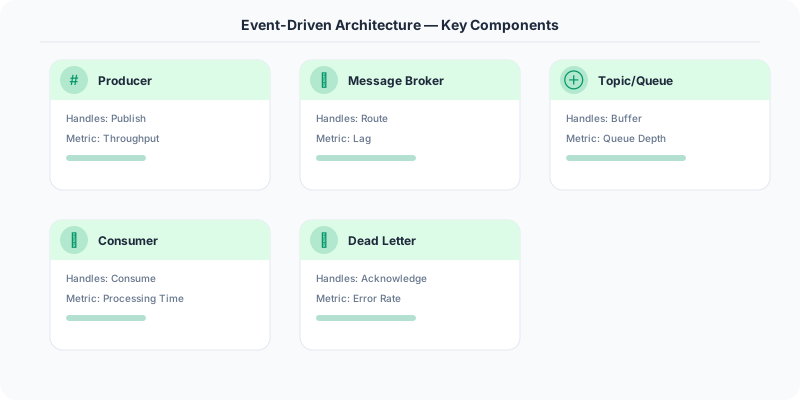
Track event-driven health as a named dashboard or review item: combine one user-facing metric, one saturation metric, and one correctness metric. For Event-Driven Architecture: Events, Brokers and Loose Coupling, this keeps the discussion grounded in behavior that can be measured after deployment instead of generic advice that sounds good in an interview but never gets verified.