Peer-to-Peer Architecture
P2P eliminates the need for central servers, making systems more resilient and cost-effective for certain use cases.
Quick answer: Peer-to-Peer Architecture
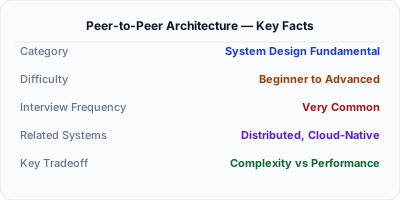
Peer-to-Peer Architecture is covered here as a practical system design concept. P2P eliminates the need for central servers, making systems more resilient and cost-effective for certain use cases. Use it to understand the Architecture Patterns idea, where it appears in production systems, and how to discuss it clearly in interviews.
Focus on the problem being solved, the main design choice, the failure mode, and the tradeoff you would defend in front of a senior engineer. This page is part of the DosiBridge system design knowledge graph, so it links related concepts, interview problems, tradeoffs, and references instead of leaving the topic isolated.
What Peer-to-Peer Architecture Actually Means
Peer-to-Peer (P2P) architecture distributes workload among equal participants (peers) without a central server. Each peer acts as both client and server — sharing resources, data, or computing power directly with other peers.
When to Use It (and When Not To)
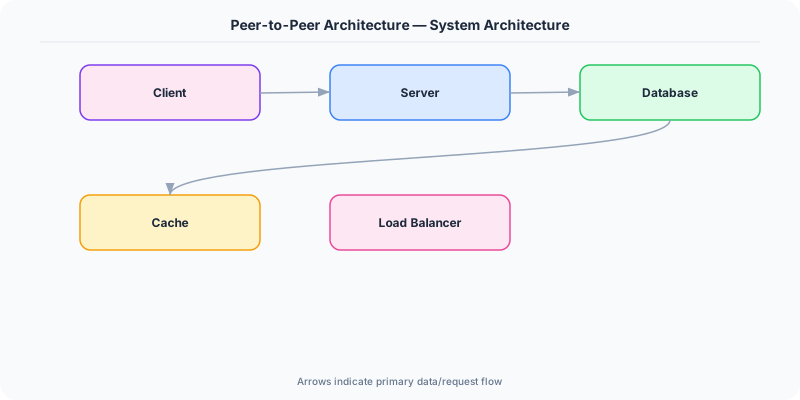
P2P eliminates the need for central servers, making systems more resilient and cost-effective for certain use cases. It powers file sharing (BitTorrent), cryptocurrency (Bitcoin), and real-time communication (WebRTC).
The Architecture
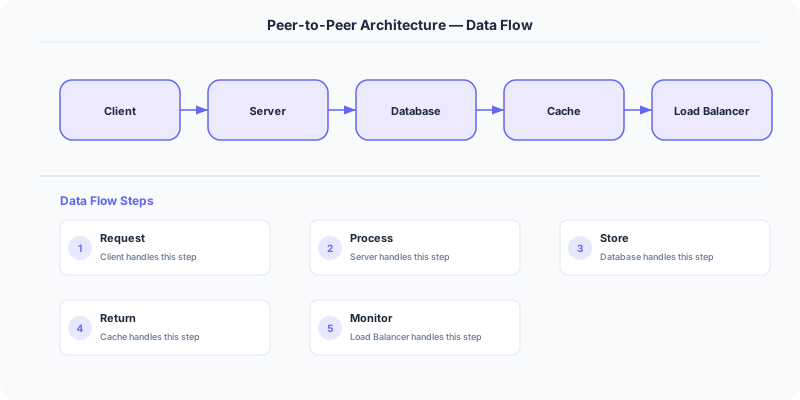
In BitTorrent: A file is split into pieces. Each peer downloads pieces from multiple other peers simultaneously and uploads pieces it has to others. The more popular a file, the more peers are sharing it, and the faster downloads become. A tracker (or DHT) helps peers find each other.
Key Principles
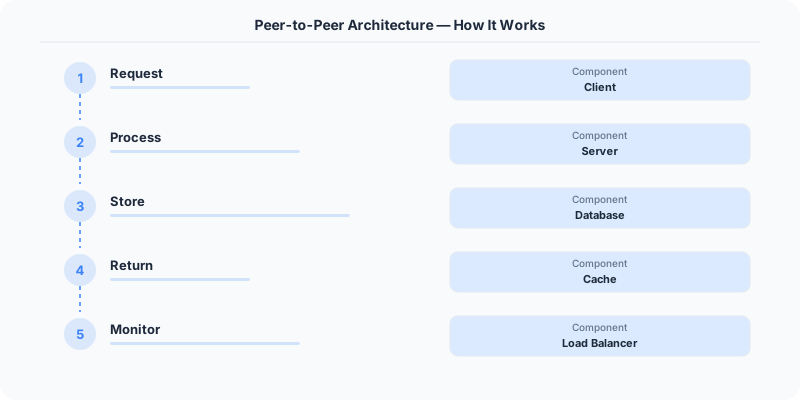
- Decentralization: No central server. Each peer contributes resources and consumes resources.
- Self-organizing: Peers discover each other through DHTs (Distributed Hash Tables), gossip, or tracker servers.
- Resilience: No single point of failure. The network continues functioning as peers join and leave.
- Resource sharing: Each peer contributes bandwidth, storage, or computing power. More peers = more capacity.
- Challenges: NAT traversal (peers behind firewalls), free-riding (peers consuming without contributing), security (no central authority).
Who Does This Well
BitTorrent distributes large files without centralized hosting. A popular Linux ISO can be downloaded faster than from a single server.
Bitcoin uses P2P for transaction propagation and block distribution. Every full node stores the entire blockchain.
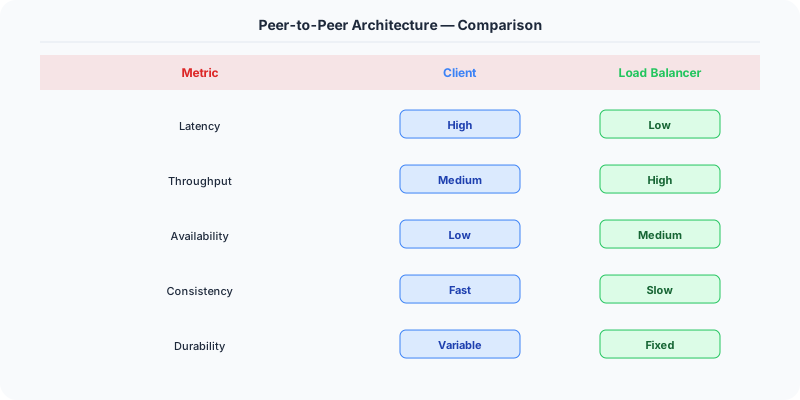
WebRTC enables peer-to-peer video/audio calls in browsers without a central server (though signaling servers help establish connections).
The Hard Parts Nobody Talks About
- Assuming P2P is always better than client-server — centralization is simpler for most applications
- Not handling NAT traversal — most devices are behind NATs and cannot receive incoming connections directly
- Not incentivizing participation — free-riders degrade network quality
The Tradeoffs
- Decentralization vs Control: No central authority means no censorship but also no moderation.
- Scalability vs Consistency: P2P scales naturally but maintaining consistent state is hard.
- Security: Without a central authority, peers must trust each other or use cryptographic verification.
Interview Angles
- What is P2P architecture and when is it used?
- What are the advantages of P2P over client-server?
- How does BitTorrent work?
- What are the challenges of P2P systems?
Keep Learning
Original DosiBridge notes for Peer-to-Peer Architecture
This section is written specifically for this page, not copied from a general system-design checklist. The useful way to study Peer-to-Peer Architecture is to connect the concept to a production service where growth exposes the first weak assumption in the original design. That framing changes the design discussion from definitions to operating choices.
What makes this topic distinct
- Ownership Boundary: For Peer-to-Peer Architecture, decide the ownership boundary before choosing tools; otherwise the design looks clean but fails when peer changes.
- Blast Radius: For Peer-to-Peer Architecture, decide the blast radius before choosing tools; otherwise the design looks clean but fails when to changes.
- Deployment Path: For Peer-to-Peer Architecture, decide the deployment path before choosing tools; otherwise the design looks clean but fails when peer changes.
- Runtime Coupling: For Peer-to-Peer Architecture, decide the runtime coupling before choosing tools; otherwise the design looks clean but fails when peer changes.
- Operational Handoff: For Peer-to-Peer Architecture, decide the operational handoff before choosing tools; otherwise the design looks clean but fails when to changes.
Production review question
If a team adopts Peer-to-Peer Architecture, what observable signal proves it helped instead of only making the architecture diagram more fashionable?
Practical metric to track
Track peer-peer health as a named dashboard or review item: combine one user-facing metric, one saturation metric, and one correctness metric. For Peer-to-Peer Architecture, this keeps the discussion grounded in behavior that can be measured after deployment instead of generic advice that sounds good in an interview but never gets verified.