Gossip Protocol
Gossip protocols enable decentralized failure detection, membership management, and data dissemination without a central coordinator.
Quick answer: Gossip Protocol
Gossip Protocol is covered here as a practical system design concept. Gossip protocols enable decentralized failure detection, membership management, and data dissemination without a central coordinator. Use it to understand the Distributed Systems idea, where it appears in production systems, and how to discuss it clearly in interviews.
Focus on the problem being solved, the main design choice, the failure mode, and the tradeoff you would defend in front of a senior engineer. This page is part of the DosiBridge system design knowledge graph, so it links related concepts, interview problems, tradeoffs, and references instead of leaving the topic isolated.
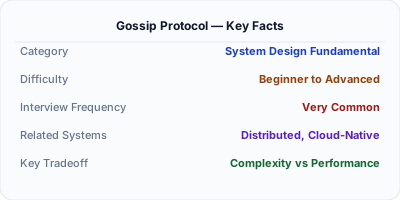
The Problem Gossip Protocol Solves
Gossip protocols enable decentralized failure detection, membership management, and data dissemination without a central coordinator. They scale well and are highly resilient to node failures.
How It Works Under the Hood
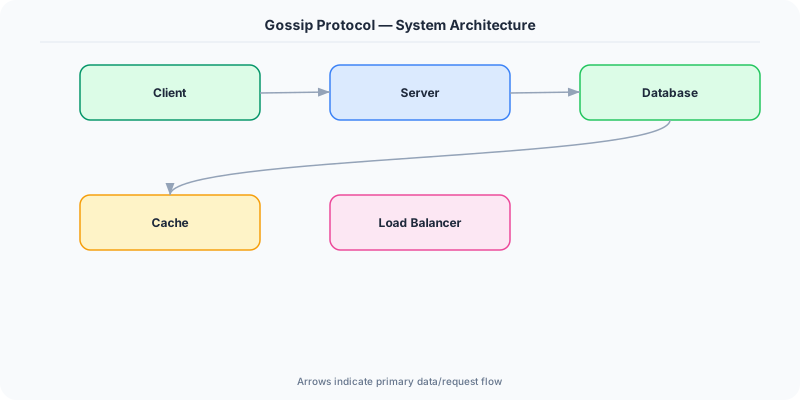
Gossip protocol is a peer-to-peer communication method where each node periodically selects a random peer and exchanges state information. Like how rumors spread in a social group, information eventually reaches all nodes. Also called 'epidemic protocol.'
Every second, Node A picks a random peer (Node C) and sends its state table: {A: alive@t1, B: alive@t2, D: suspect@t3}. Node C merges this with its own table, keeping the most recent information. Next second, Node C gossips with Node E, propagating A's information further.
Within a few rounds, all nodes have consistent knowledge of cluster membership and health — without any central authority.
The Mental Model
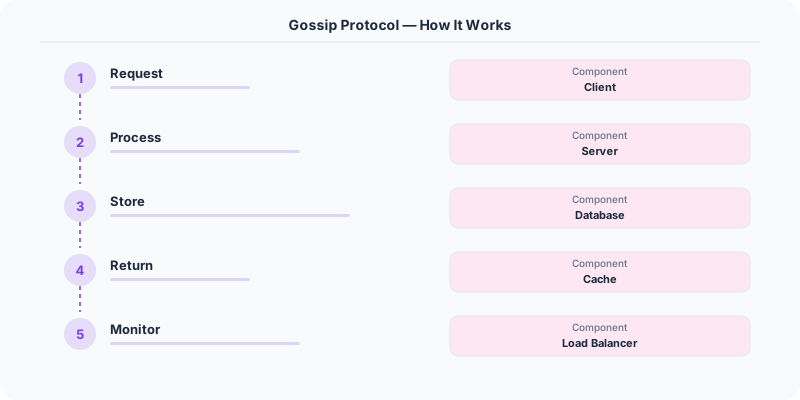
- Random peer selection: Each node periodically picks a random peer to exchange information.
- Convergence: Information spreads exponentially — after O(log N) rounds, all N nodes have the information.
- Failure detection: Nodes gossip about each other's health. If a node is not reported alive by any peer, it is suspected failed.
- Crux: No single point of failure. Even if half the nodes fail, gossip continues among survivors.
- Membership: Nodes join and leave dynamically. The gossip protocol propagates membership changes.
Real Systems That Depend on This
Cassandra uses gossip for cluster membership and failure detection. Every 1 second, each node gossips with 1-3 peers.
Consul uses the SWIM protocol (a gossip variant) for health checking and service discovery.
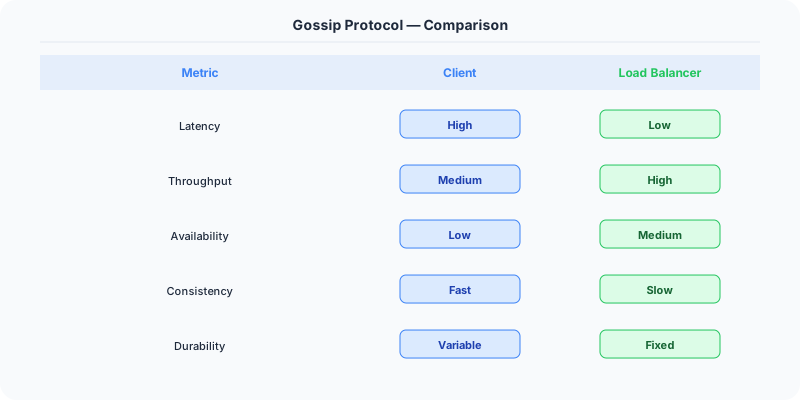
Amazon S3 uses anti-entropy gossip to detect and repair inconsistent replicas.
Where This Shows Up in Interviews
- How does gossip protocol work?
- What are the advantages of gossip over a centralized approach?
- How fast does information propagate in gossip?
- What are the limitations of gossip protocol?
Tradeoffs
- Eventual consistency: Gossip provides eventual consistency — information takes time to propagate.
- Bandwidth: Gossip messages consume network bandwidth, proportional to cluster size.
- False positives: Gossip-based failure detection can incorrectly mark healthy nodes as failed during network partitions.
Watch Out For
- Not tuning gossip frequency — too slow delays failure detection, too fast wastes bandwidth
- Relying on gossip for strong consistency — it only provides eventual consistency
- Not handling network partitions — one half of the cluster may mark the other half as failed
Go Deeper
- heartbeats — start here if this is new to you
- Service Discovery
- consensus-algorithms
- fault-tolerance
Original DosiBridge notes for Gossip Protocol
This section is written specifically for this page, not copied from a general system-design checklist. The useful way to study Gossip Protocol is to connect the concept to a production service where growth exposes the first weak assumption in the original design. That framing changes the design discussion from definitions to operating choices.
What makes this topic distinct
- Membership: For Gossip Protocol, decide the membership before choosing tools; otherwise the design looks clean but fails when gossip changes.
- Clock Drift: For Gossip Protocol, decide the clock drift before choosing tools; otherwise the design looks clean but fails when protocol changes.
- Retry Semantics: For Gossip Protocol, decide the retry semantics before choosing tools; otherwise the design looks clean but fails when gossip changes.
- Partition Behavior: For Gossip Protocol, decide the partition behavior before choosing tools; otherwise the design looks clean but fails when protocol changes.
- Reconciliation: For Gossip Protocol, decide the reconciliation before choosing tools; otherwise the design looks clean but fails when gossip changes.
Distinct angle: gossip trades precision for scalable spread
Gossip protocols are useful because every node does not need a central coordinator to learn membership or state changes. Information spreads probabilistically, which makes the system resilient but not instantly precise. The unique design discussion is fanout, convergence time, stale membership, and how the system behaves while different nodes temporarily believe different cluster views.
Production review question
If a team adopts Gossip Protocol, what observable signal proves it helped instead of only making the architecture diagram more fashionable?
Practical metric to track
Track gossip-protocol health as a named dashboard or review item: combine one user-facing metric, one saturation metric, and one correctness metric. For Gossip Protocol, this keeps the discussion grounded in behavior that can be measured after deployment instead of generic advice that sounds good in an interview but never gets verified.