Merkle Trees
Learn Merkle Trees — hash-based tree structures that enable efficient data verification, tamper detection, and synchronization in distributed systems and.
Quick answer: Merkle Trees
Merkle Trees is covered here as a practical system design concept. Learn Merkle Trees — hash-based tree structures that enable efficient data verification, tamper detection, and synchronization in distributed systems and. Use it to understand the Distributed Systems idea, where it appears in production systems, and how to discuss it clearly in interviews.
Focus on the problem being solved, the main design choice, the failure mode, and the tradeoff you would defend in front of a senior engineer. This page is part of the DosiBridge system design knowledge graph, so it links related concepts, interview problems, tradeoffs, and references instead of leaving the topic isolated.
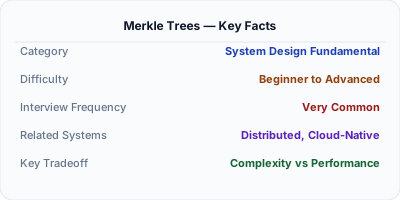
A Merkle tree is a binary tree where each leaf node contains a hash of a data block and each internal node contains a hash of its children's hashes. The root hash — a single value — summarizes the entire dataset. If any data block changes, its hash changes, cascading up through the tree to produce a different root hash. This structure enables two critical capabilities: detecting any modification to the data by checking the root hash, and identifying exactly which blocks differ by comparing only O(log n) hashes rather than the entire dataset. Merkle trees are foundational in blockchains, distributed databases, and version control systems.
| Aspect | Details |
|---|---|
| What it is | A hash tree where each node is a cryptographic hash of its children, enabling efficient data verification and difference detection in O(log n) comparisons |
| When to use | When you need to verify data integrity across untrusted networks, synchronize replicas efficiently, or detect tampering without comparing full datasets |
| When NOT to use | When the dataset is small enough that full comparison is faster than building and traversing tree structures, or when data changes so frequently the tree must be constantly rebuilt |
| Real-world example | Amazon DynamoDB uses Merkle trees for anti-entropy — comparing replicas and synchronizing only the differing partitions instead of transferring complete datasets |
| Interview tip | Draw a Merkle tree, show how a single changed leaf propagates to the root, and explain the O(log n) verification path — visual demonstration is powerful |
| Common mistake | Building Merkle trees with non-cryptographic hash functions in security-sensitive applications — MD5 or CRC32 can be collision-attacked to forge matching hashes |
| Key tradeoff | Verification speed vs. construction cost — Merkle trees make verification O(log n) but building the tree requires O(n) hash computations upfront |
Why This Matters
Distributed systems face a fundamental challenge: how do you verify that data on one node matches data on another without transferring the entire dataset? A naive approach compares every byte, requiring O(n) data transfer. Merkle trees reduce this to O(log n) by recursively halving the search space. Two nodes exchange root hashes — if they match, the data is identical. If they differ, they compare children, then grandchildren, quickly narrowing down to the specific blocks that differ. This is how DynamoDB and Cassandra synchronize replicas, how Git detects file changes, how BitTorrent verifies downloaded pieces, and how every blockchain validates transaction integrity. The Merkle tree is one of the most elegant data structures in computer science.
The Building Blocks
- Leaf Nodes: Hashes of individual data blocks — each leaf represents one piece of data (a file chunk, a database partition, a transaction) hashed with SHA-256 or similar
- Internal Nodes: Hashes computed by concatenating and hashing their children's hashes, creating a recursive chain of verification from leaves to root
- Root Hash: The single hash at the top of the tree that summarizes the entire dataset — any change anywhere in the data produces a different root hash
- Verification Path: The O(log n) set of sibling hashes needed to prove that a specific leaf belongs to a tree with a given root, without revealing the entire tree
- Anti-Entropy Repair: Using Merkle tree comparison between replicas to identify and synchronize only the differing data blocks, minimizing network transfer during repair
Under the Hood
A Merkle tree is constructed bottom-up. Given n data blocks, compute the hash of each block to create n leaf nodes. Then pair adjacent leaves and hash the concatenation of each pair to create the parent level. Continue until a single root hash remains. For a dataset of 1 million blocks, the tree has about 20 levels (log2 of 1,000,000), meaning any verification requires at most 20 hash comparisons.
The verification path (also called a Merkle proof) is remarkably efficient. To prove that block B exists in a tree with root R, you provide B, its hash, and the sibling hash at each level up to the root — about 20 hashes for a million-block tree. The verifier recomputes hashes up the tree and checks that the result matches R. This is how light clients in blockchains verify transactions without downloading the entire chain — they only need the block headers (containing root hashes) and the Merkle proof for their transactions.
For anti-entropy in databases like Cassandra and DynamoDB, each replica maintains a Merkle tree over its data partitions. During synchronization, replicas compare root hashes. If roots match, no action needed. If they differ, the comparison descends level by level, identifying only the partitions that have diverged. Only those partitions are transferred and reconciled. This approach transforms an O(n) full-scan synchronization into an O(log n) targeted repair, making it practical to continuously verify consistency across thousands of replicas with minimal network overhead.
How Companies Actually Do This
Amazon DynamoDB uses Merkle trees for anti-entropy repair between replicas, comparing partition trees to identify and synchronize only the data ranges that have diverged across storage nodes
Bitcoin Every block contains a Merkle root of its transactions, enabling SPV (Simplified Payment Verification) clients to verify specific transactions without downloading the entire 500+ GB blockchain
Git Uses Merkle tree structures (tree objects containing hashes of blobs and subtrees) to efficiently detect which files changed between commits and verify repository integrity
Common Pitfalls
- Using weak hash functions (MD5, CRC32) for Merkle trees in security-sensitive applications — collision attacks can forge data blocks that produce the same hash as legitimate ones
- Not handling odd numbers of leaf nodes consistently — padding or duplicating the last leaf affects tree structure and must be agreed upon by all participants
- Rebuilding the entire tree on every data change instead of incrementally updating only the affected path — wastes O(n) computation when O(log n) suffices
Interview Questions Worth Practicing
- How does a Merkle tree enable verification of data integrity in O(log n) time instead of O(n)?
- How do distributed databases like Cassandra use Merkle trees for anti-entropy repair between replicas?
- What is a Merkle proof and how do blockchain light clients use it to verify transactions?
The Tradeoffs
- Verification Speed vs. Build Cost: Merkle trees enable O(log n) verification but require O(n) hash computations to construct initially
- Tree Depth vs. Fan-out: Binary trees maximize depth (more comparisons) but are simplest; wider fan-out reduces depth but increases per-node comparison cost
- Hash Strength vs. Performance: Cryptographic hashes (SHA-256) provide collision resistance for security; faster hashes (xxHash) suit internal synchronization where adversarial resistance is unnecessary
How to Explain This in an Interview
Here is how I would explain Merkle Trees in a system design interview:
A Merkle tree is a hash tree where each leaf hashes a data block and each internal node hashes its children. The root hash summarizes the entire dataset — any change anywhere produces a different root. The key insight is efficiency: to verify a single block or find differences between two datasets, you only need O(log n) comparisons instead of checking every block. DynamoDB and Cassandra use Merkle trees for anti-entropy — replicas compare root hashes, descend where they differ, and synchronize only the divergent partitions. Blockchains use Merkle proofs to let light clients verify transactions with just 20 hashes instead of the full chain. I would use SHA-256 for security-sensitive applications and faster hashes like xxHash for internal replica synchronization.
Related Topics
Original DosiBridge notes for Merkle Trees
This section is written specifically for this page, not copied from a general system-design checklist. The useful way to study Merkle Trees is to connect the concept to a production service where growth exposes the first weak assumption in the original design. That framing changes the design discussion from definitions to operating choices.
What makes this topic distinct
- Membership: For Merkle Trees, decide the membership before choosing tools; otherwise the design looks clean but fails when merkle changes.
- Clock Drift: For Merkle Trees, decide the clock drift before choosing tools; otherwise the design looks clean but fails when trees changes.
- Retry Semantics: For Merkle Trees, decide the retry semantics before choosing tools; otherwise the design looks clean but fails when merkle changes.
- Partition Behavior: For Merkle Trees, decide the partition behavior before choosing tools; otherwise the design looks clean but fails when trees changes.
- Reconciliation: For Merkle Trees, decide the reconciliation before choosing tools; otherwise the design looks clean but fails when merkle changes.
Production review question
If a team adopts Merkle Trees, what observable signal proves it helped instead of only making the architecture diagram more fashionable?
Practical metric to track
Track merkle-trees health as a named dashboard or review item: combine one user-facing metric, one saturation metric, and one correctness metric. For Merkle Trees, this keeps the discussion grounded in behavior that can be measured after deployment instead of generic advice that sounds good in an interview but never gets verified.