Single Point of Failure (SPOF)
Identifying and eliminating SPOFs is one of the first things an interviewer expects in a system design discussion.
Quick answer: Single Point of Failure (SPOF)
Single Point of Failure (SPOF) is covered here as a practical system design concept. Identifying and eliminating SPOFs is one of the first things an interviewer expects in a system design discussion. Use it to understand the Core Concepts idea, where it appears in production systems, and how to discuss it clearly in interviews.
Focus on the problem being solved, the main design choice, the failure mode, and the tradeoff you would defend in front of a senior engineer. This page is part of the DosiBridge system design knowledge graph, so it links related concepts, interview problems, tradeoffs, and references instead of leaving the topic isolated.
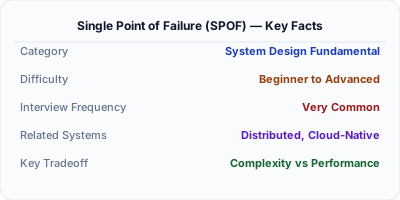
The Core Idea
A Single Point of Failure (SPOF) is any component in a system whose failure causes the entire system to stop functioning. If your system depends on a single database server, a single load balancer, or a single DNS provider, that component is a SPOF.
Step-by-Step Walkthrough
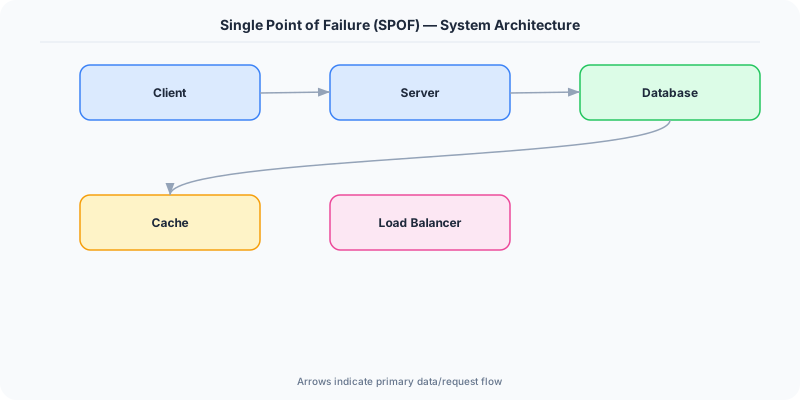
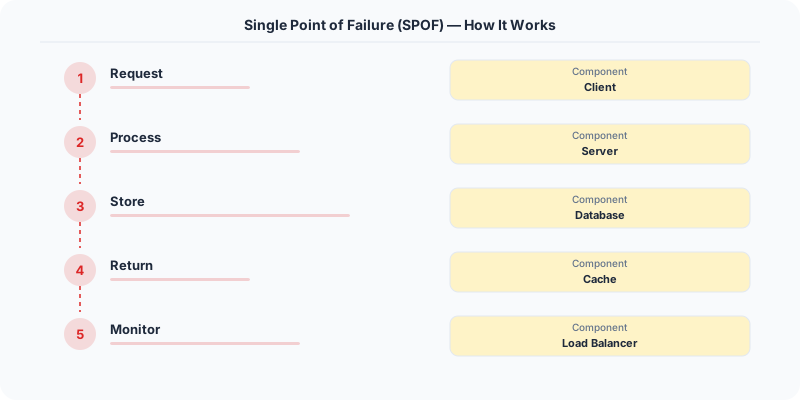
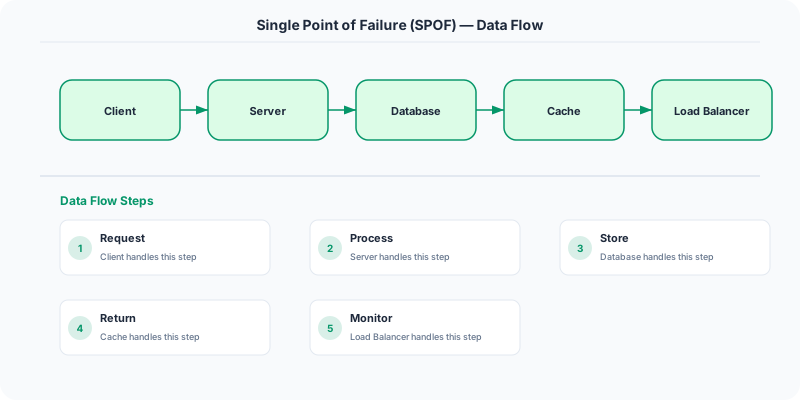
Eliminating SPOFs follows a systematic process: (1) Map every component and dependency. (2) Identify which are single points of failure. (3) Add redundancy — multiple instances, replicas, or alternative paths. (4) Test failover to verify the redundancy actually works. (5) Monitor health continuously.
Common SPOF solutions: Multiple load balancers with DNS failover. Database primary-replica replication with automatic promotion. Multi-region deployment. Multiple cloud provider DNS (Route53 + Cloudflare).
Why This Approach Wins
- Identify SPOFs systematically: Walk through every component in your architecture diagram and ask 'What happens if this fails?' If the answer is 'the system goes down,' that is a SPOF.
- Redundancy eliminates SPOFs: Run at least 2 instances of every critical component across different failure domains (different servers, racks, or data centers).
- SPOFs can be subtle: A shared configuration file, a single DNS provider, a single cloud region, or even a single engineer who knows how the system works can be SPOFs.
- Cost of redundancy scales with criticality: Not every component needs triple redundancy. Prioritize by business impact of failure.
In Production
2017 Amazon S3 outage: A single engineer's typo took down S3 in us-east-1, causing cascading failures across thousands of websites. This was a hidden SPOF — many services assumed S3 would always be available.
GitHub eliminated their database SPOF by implementing MySQL replication with automatic failover using orchestrator.
Cloudflare runs BGP Anycast across 300+ cities so that no single point of failure can take down their network.
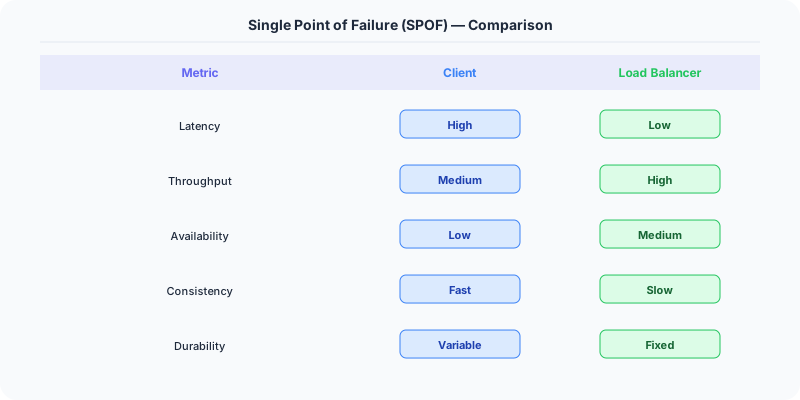
Tradeoffs and Limitations
- Redundancy vs. Cost: Eliminating every SPOF requires doubling (or tripling) infrastructure.
- Complexity vs. Reliability: More redundancy means more components to coordinate and more potential for split-brain scenarios.
Production Gotchas
- Adding redundancy without testing failover
- Not considering correlated failures (all replicas in the same rack)
- Overlooking operational SPOFs — the one engineer who knows the deployment process
The Interview Angle
- How do you identify single points of failure in a system?
- What are common SPOFs in web architectures?
- How do you eliminate a database SPOF?
- Can a load balancer itself be a SPOF? How do you solve it?
Next Up
Original DosiBridge notes for Single Point of Failure (SPOF)
This section is written specifically for this page, not copied from a general system-design checklist. The useful way to study Single Point of Failure (SPOF) is to connect the concept to a production service where growth exposes the first weak assumption in the original design. That framing changes the design discussion from definitions to operating choices.
What makes this topic distinct
- SLO: For Single Point of Failure (SPOF), decide the SLO before choosing tools; otherwise the design looks clean but fails when spof changes.
- Capacity Headroom: For Single Point of Failure (SPOF), decide the capacity headroom before choosing tools; otherwise the design looks clean but fails when spof changes.
- Failure Mode: For Single Point of Failure (SPOF), decide the failure mode before choosing tools; otherwise the design looks clean but fails when spof changes.
- Degradation Path: For Single Point of Failure (SPOF), decide the degradation path before choosing tools; otherwise the design looks clean but fails when spof changes.
- Operator Signal: For Single Point of Failure (SPOF), decide the operator signal before choosing tools; otherwise the design looks clean but fails when spof changes.
Distinct angle: SPOF removal needs dependency proof
A single point of failure is often hidden in DNS, secrets, migrations, cron jobs, or a shared database rather than the obvious web server. Removing SPOFs means proving that failover works under a real dependency outage. The useful review asks: if this component disappears for ten minutes, which user action stops and which runbook restores it?
Production review question
If a team adopts Single Point of Failure (SPOF), what observable signal proves it helped instead of only making the architecture diagram more fashionable?
Practical metric to track
Track spof health as a named dashboard or review item: combine one user-facing metric, one saturation metric, and one correctness metric. For Single Point of Failure (SPOF), this keeps the discussion grounded in behavior that can be measured after deployment instead of generic advice that sounds good in an interview but never gets verified.