API Design Best Practices
APIs are contracts — once published, they are hard to change without breaking clients. Good design from the start saves years of technical debt.
Quick answer: API Design Best Practices
API Design Best Practices is covered here as a practical system design concept. APIs are contracts — once published, they are hard to change without breaking clients. Good design from the start saves years of technical debt. Use it to understand the APIs idea, where it appears in production systems, and how to discuss it clearly in interviews.
Focus on the problem being solved, the main design choice, the failure mode, and the tradeoff you would defend in front of a senior engineer. This page is part of the DosiBridge system design knowledge graph, so it links related concepts, interview problems, tradeoffs, and references instead of leaving the topic isolated.
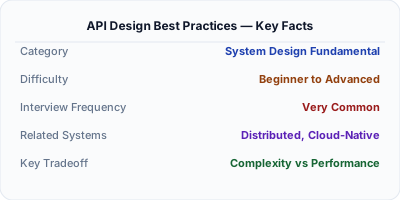
API design is the process of defining endpoints, request/response formats, authentication, error handling, versioning, and documentation for an API. Good API design creates intuitive, consistent, and maintainable interfaces that developers enjoy using.
Why This Matters
APIs are contracts — once published, they are hard to change without breaking clients. Good design from the start saves years of technical debt. Stripe, Twilio, and GitHub are successful partly because their APIs are a joy to use.
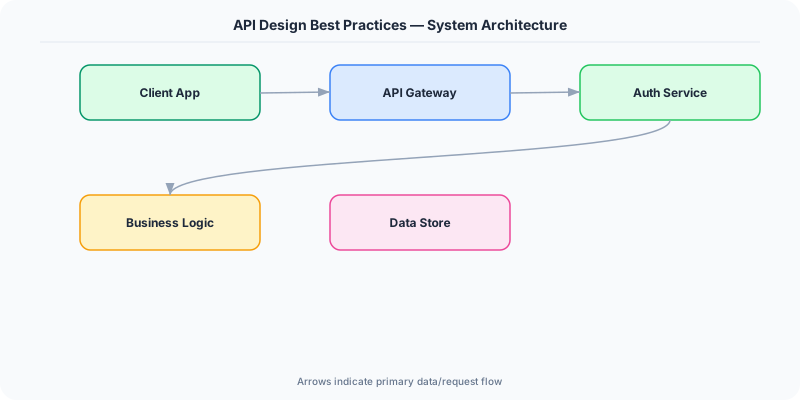
The Building Blocks
- Use nouns for resources: GET /users, not GET /getUsers. POST /orders, not POST /createOrder.
- Use HTTP methods correctly: GET for reading, POST for creating, PUT for replacing, PATCH for partial updates, DELETE for removing.
- Consistent error format: Every error should include: HTTP status code, error code, human-readable message, and optionally a link to documentation.
- Pagination: Always paginate list endpoints. Use cursor-based pagination for real-time data, offset-based for simple cases.
- Versioning: Include version in URL (/api/v1/) or header (Accept: application/vnd.myapi.v1+json). Never break existing clients.
Under the Hood
Start by identifying your resources (users, orders, products). Define CRUD endpoints for each. Design the request/response JSON schemas. Add authentication (OAuth2, API keys). Add rate limiting. Write comprehensive documentation with examples. Version from day one.
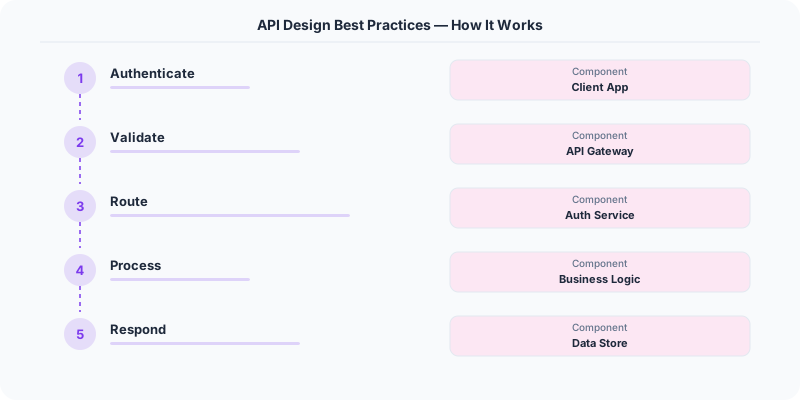
Good APIs follow the Principle of Least Surprise — developers should be able to guess how an endpoint works based on the patterns they have already seen in your API.
How Companies Actually Do This
Stripe: RESTful, consistent naming, expandable objects (include related data on demand), excellent error messages.
Twilio: Clear resource hierarchy (/Accounts/{sid}/Messages), comprehensive examples in every language.
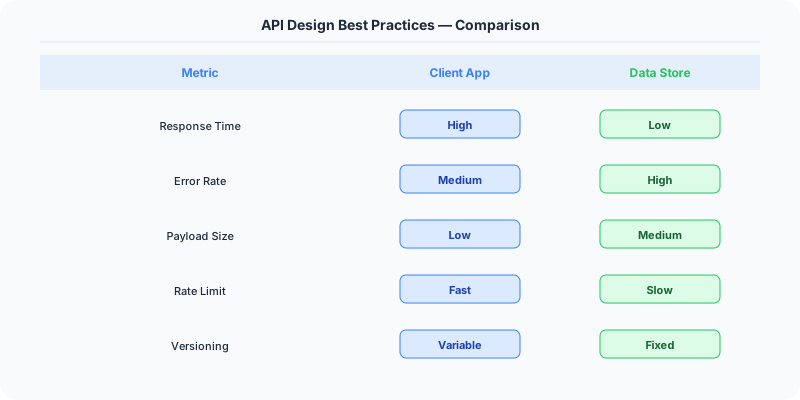
GitHub: Supports both REST and GraphQL, with HATEOAS links in REST responses.
Common Pitfalls
- Using verbs in URLs (GET /getUser/123 instead of GET /users/123)
- Returning 200 for errors with error details in the body
- Not implementing pagination — a list of 1 million items crashes clients
- Exposing internal data model directly as the API — couples API to implementation
Interview Questions Worth Practicing
- How would you design the API for a social media platform?
- What makes an API developer-friendly?
- How do you handle API versioning?
- What is pagination and how do you implement it?
The Tradeoffs
- REST vs RPC-style: REST is more standardized; RPC-style (POST /searchUsers) is sometimes more natural for complex operations.
- Thin vs Fat APIs: Returning minimal data is faster but requires more requests; returning everything saves round trips but wastes bandwidth.
- Strict vs Flexible: Strict validation catches bugs early; flexible APIs are more forgiving to clients.
Related Topics
Differentiation note: this page is about designing the contract
This API design page focuses on shaping a long-lived contract. It is intentionally different from the introductory API page: here the work is choosing resource boundaries, error models, pagination rules, versioning policy, and operational guardrails before teams build clients against the interface.
Contract design checklist
- Model resources around business capabilities, not database tables.
- Choose whether the endpoint is command-oriented, resource-oriented, query-oriented, or workflow-oriented.
- Define a stable error envelope with machine-readable codes.
- Document idempotency behavior for retries and client timeouts.
- Pick pagination style based on data volatility: cursor pagination for fast-changing collections, offset pagination only for simple admin lists.
- Add compatibility rules for new fields, removed fields, enum changes, and required inputs.
- Create examples for success, validation failure, authorization failure, conflict, rate limit, and downstream outage.
Example: designing an orders API
A production orders API should explain what happens when inventory is pending, when payment authorization is delayed, and when the client retries after a timeout. A strong design may return an order resource with explicit state instead of pretending checkout is always synchronous. That makes the API resilient to real payment, fraud, and inventory delays.
Review questions
Before shipping an API, ask: Can old clients keep working? Can a request be safely retried? Can support debug a failed request from the response and request ID? Can the team add new behavior without breaking external integrations? Those answers are what make API design a systems topic.
Original DosiBridge notes for API Design Best Practices
This section is written specifically for this page, not copied from a general system-design checklist. The useful way to study API Design Best Practices is to connect the concept to an integration boundary where bad contracts become customer-facing outages. That framing changes the design discussion from definitions to operating choices.
What makes this topic distinct
- Contract Evolution: For API Design Best Practices, decide the contract evolution before choosing tools; otherwise the design looks clean but fails when api changes.
- Idempotency: For API Design Best Practices, decide the idempotency before choosing tools; otherwise the design looks clean but fails when design changes.
- Pagination: For API Design Best Practices, decide the pagination before choosing tools; otherwise the design looks clean but fails when api changes.
- Error Shape: For API Design Best Practices, decide the error shape before choosing tools; otherwise the design looks clean but fails when design changes.
- Consumer Compatibility: For API Design Best Practices, decide the consumer compatibility before choosing tools; otherwise the design looks clean but fails when api changes.
Production review question
If a team adopts API Design Best Practices, what observable signal proves it helped instead of only making the architecture diagram more fashionable?
Practical metric to track
Track api-design health as a named dashboard or review item: combine one user-facing metric, one saturation metric, and one correctness metric. For API Design Best Practices, this keeps the discussion grounded in behavior that can be measured after deployment instead of generic advice that sounds good in an interview but never gets verified.