Top 15 System Design Tradeoffs
System design is fundamentally about making tradeoffs. There is no perfect architecture — every decision involves choosing between competing concerns.
Quick answer: Top 15 System Design Tradeoffs
Top 15 System Design Tradeoffs is covered here as a practical architecture tradeoff. System design is fundamentally about making tradeoffs. There is no perfect architecture — every decision involves choosing between competing concerns. Use it when comparing two architecture choices and explaining the operational cost, latency, reliability, and team-complexity impact of each option.
Focus on the problem being solved, the main design choice, the failure mode, and the tradeoff you would defend in front of a senior engineer. This page is part of the DosiBridge system design knowledge graph, so it links related concepts, interview problems, tradeoffs, and references instead of leaving the topic isolated.
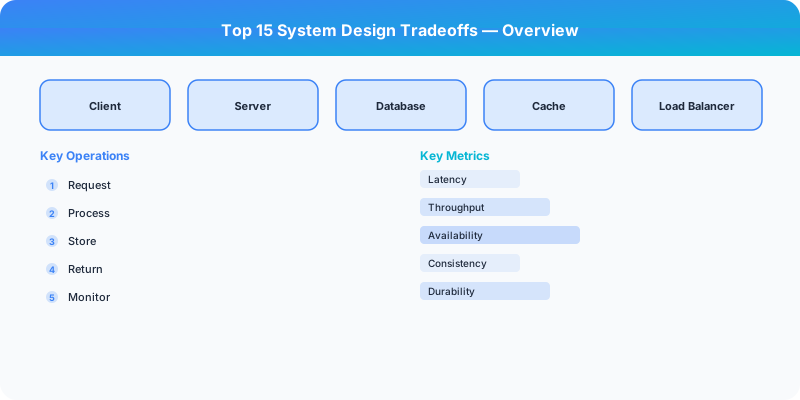
Optimize for X vs Balance everything
System design is fundamentally about making tradeoffs. There is no perfect architecture — every decision involves choosing between competing concerns. The ability to articulate tradeoffs is what separates junior from senior engineers in interviews and in practice.
The Case for Optimize for X
Choosing one quality attribute (performance, consistency, simplicity)
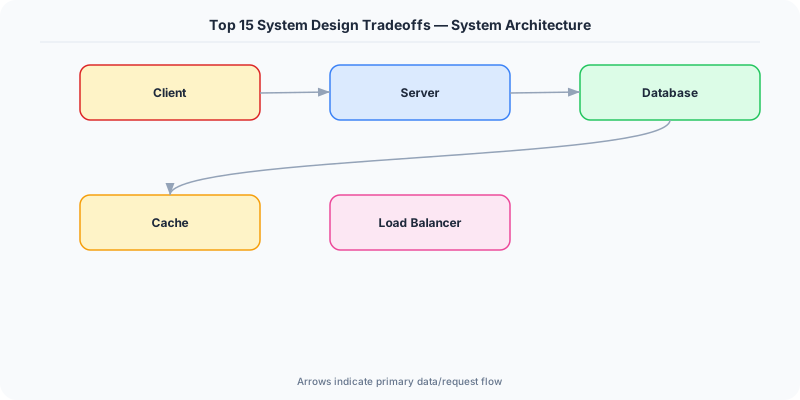
What you gain: Clear optimization target. Simpler implementation. Easier to reason about.
What you lose: Sacrifices other qualities. May not meet all requirements.
Best when: The system has a clear primary concern; One attribute is significantly more important than others.
The Case for Balance everything
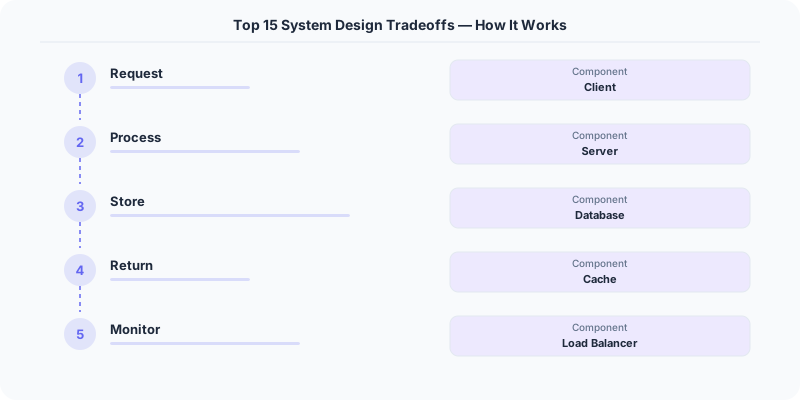
Trying to satisfy all quality attributes equally
What you gain: Well-rounded system. Handles diverse requirements.
What you lose: Mediocre at everything. More complex. Higher cost.
Best when: No single attribute dominates; The system serves diverse use cases.
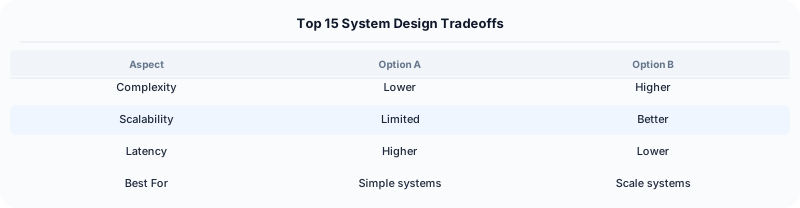
Side-by-Side
| Optimize for X | Balance everything | |
|---|---|---|
| Strengths | Clear optimization target | Well-rounded system |
| Weakness | Sacrifices other qualities | Mediocre at everything |
| Use when | The system has a clear primary concern | No single attribute dominates |
In the Real World
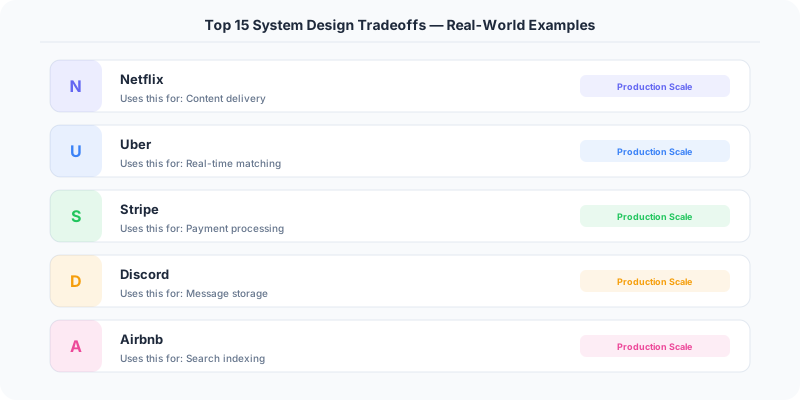
Netflix optimizes for availability over consistency — a slightly stale recommendation is better than no recommendation.
Banking systems optimize for consistency over performance — a wrong account balance is unacceptable.
Gaming systems optimize for latency over durability — losing a few seconds of game state is acceptable.
The Interview Take
Always discuss tradeoffs proactively in interviews. After proposing a design, say: 'The tradeoff here is X vs Y. I chose X because of requirement Z. If requirement W was more important, I would choose Y instead.' This demonstrates senior-level thinking.
Source | System-Design-Overview
Why Tradeoffs Matter More Than Solutions
In system design interviews, interviewers are not testing whether you know the "right" answer. They are testing whether you understand the tradeoffs behind each decision. A senior engineer knows that every architectural choice has consequences — choosing one approach means accepting its limitations.
The Framework for Evaluating Any Tradeoff
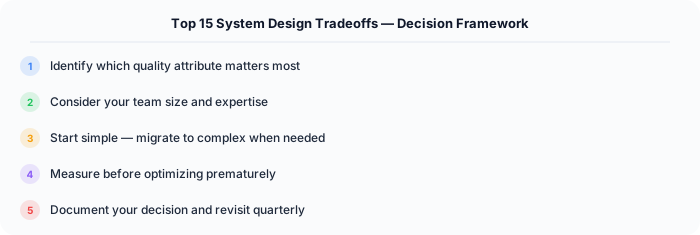
When you face any system design decision, evaluate it across these dimensions:
-
Complexity vs Performance: A simpler solution (monolith, single database) is easier to operate but may not scale. A complex solution (microservices, sharded database) scales further but requires more engineering effort to build and maintain.
-
Consistency vs Availability: The CAP theorem formalizes this — in a network partition, you must choose between consistent data and available service. Banks choose consistency. Social media chooses availability.
-
Latency vs Throughput: Optimizing for individual request speed (low latency) often conflicts with maximizing total requests handled (high throughput). Batching improves throughput at the cost of per-request latency.
-
Cost vs Performance: You can always improve performance by spending more on infrastructure. The engineering challenge is finding the right balance — Netflix does not cache everything, only the content accessed by 90% of users.
How Top Companies Think About Tradeoffs
Amazon: "Two-pizza teams" — they chose organizational simplicity (small teams) even though it creates more service boundaries and operational overhead. The tradeoff: more microservices to manage, but faster development velocity.
Google: Chose strong consistency for Spanner (their global database) despite the latency cost. The tradeoff: every cross-region write takes longer, but application developers never deal with stale data.
Netflix: Chose eventual consistency for their content catalog. The tradeoff: a newly released show might take 30 seconds to appear for all users, but the system handles 200+ million subscribers without consistency bottlenecks.
Interview Strategy
When discussing tradeoffs in an interview:
- Always state both sides clearly: "We could use X, which gives us A but costs us B. Or Y, which gives us C but costs us D."
- Make a decision and justify it: "Given our requirements for low latency, I would choose X because..."
- Acknowledge the downsides: "The tradeoff is that we accept higher storage costs and more operational complexity."
- Mention a mitigation: "To address the downside, we could implement Z as a safeguard."
This pattern shows mature engineering judgment — the #1 trait interviewers look for in senior candidates.
Original DosiBridge notes for Top 15 System Design Tradeoffs
This section is written specifically for this page, not copied from a general system-design checklist. The useful way to study Top 15 System Design Tradeoffs is to connect the concept to a production service where growth exposes the first weak assumption in the original design. That framing changes the design discussion from definitions to operating choices.
What makes this topic distinct
- Decision Boundary: For Top 15 System Design Tradeoffs, decide the decision boundary before choosing tools; otherwise the design looks clean but fails when top changes.
- Reversal Cost: For Top 15 System Design Tradeoffs, decide the reversal cost before choosing tools; otherwise the design looks clean but fails when 15 changes.
- Operating Cost: For Top 15 System Design Tradeoffs, decide the operating cost before choosing tools; otherwise the design looks clean but fails when tradeoffs changes.
- Team Maturity: For Top 15 System Design Tradeoffs, decide the team maturity before choosing tools; otherwise the design looks clean but fails when top changes.
- Growth Trigger: For Top 15 System Design Tradeoffs, decide the growth trigger before choosing tools; otherwise the design looks clean but fails when 15 changes.
Production review question
If a team adopts Top 15 System Design Tradeoffs, what observable signal proves it helped instead of only making the architecture diagram more fashionable?
Practical metric to track
Track top-tradeoffs health as a named dashboard or review item: combine one user-facing metric, one saturation metric, and one correctness metric. For Top 15 System Design Tradeoffs, this keeps the discussion grounded in behavior that can be measured after deployment instead of generic advice that sounds good in an interview but never gets verified.