Stateful vs Stateless Design
Stateless services do not store client state between requests — each request is independent.
Quick answer: Stateful vs Stateless Design
Stateful vs Stateless Design is covered here as a practical architecture tradeoff. Stateless services do not store client state between requests — each request is independent. Use it when comparing two architecture choices and explaining the operational cost, latency, reliability, and team-complexity impact of each option.
Focus on the problem being solved, the main design choice, the failure mode, and the tradeoff you would defend in front of a senior engineer. This page is part of the DosiBridge system design knowledge graph, so it links related concepts, interview problems, tradeoffs, and references instead of leaving the topic isolated.
The Tradeoff
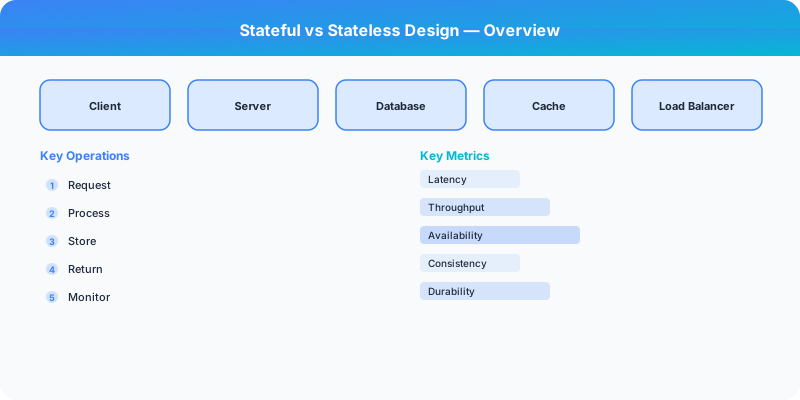
Stateless services do not store client state between requests — each request is independent. Stateful services maintain state across requests (e.g., WebSocket connections, session data, in-memory caches).
Stateless: A Closer Look
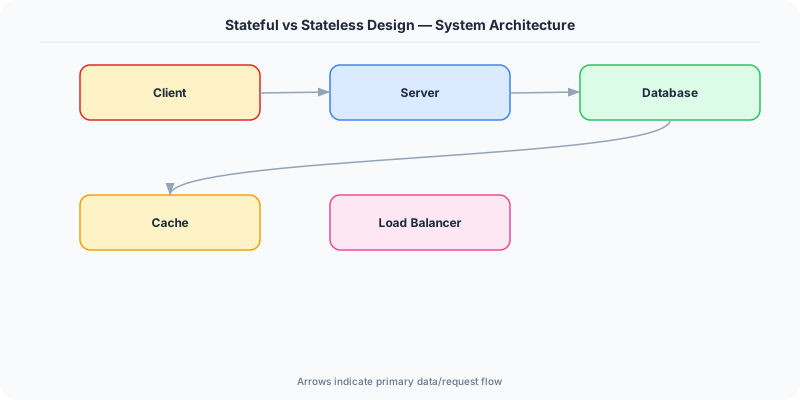
No server-side state. All state is in the request or an external store (database, Redis).
The Good
- Easy to scale horizontally (any server can handle any request)
- Simple failover (no state to lose)
- Load balancing is straightforward
The Bad
- Every request must carry all needed context
- External state store adds latency
- Not suitable for real-time connections
Stateful: A Closer Look
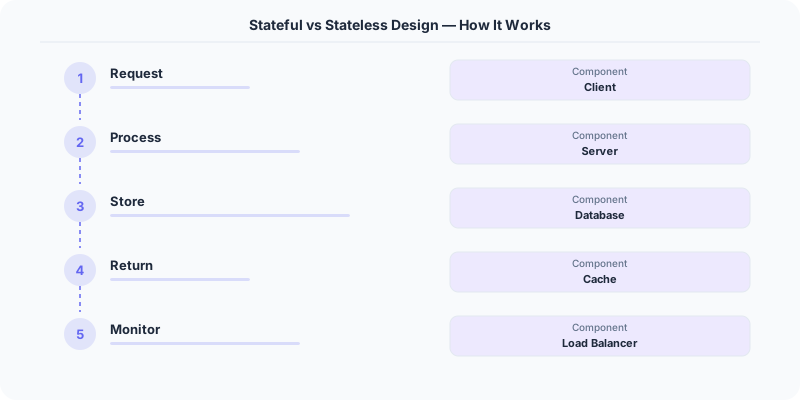
Server maintains state between requests. WebSocket connections, in-memory caches, gaming sessions.
The Good
- Faster access to state (in memory)
- Natural for persistent connections
- Can maintain complex session logic
The Bad
- Hard to scale (sticky sessions needed)
- Failover loses state
- Load balancing is complex
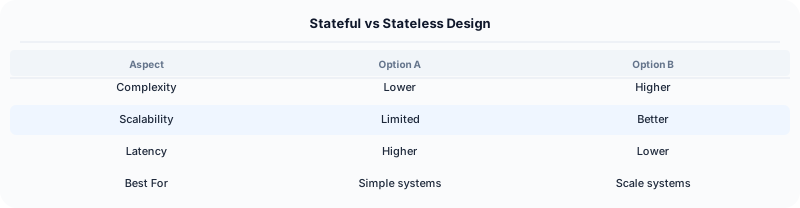
Quick Comparison
| Stateless | Stateful | |
|---|---|---|
| Best for | REST APIs | WebSocket connections |
Real-World Examples
REST APIs are stateless by design — authentication is passed via tokens in every request.
WebSocket servers (Slack, Discord) are stateful — each server holds thousands of persistent connections.
Redis is a stateful service — it holds data in memory that would be lost on restart (solved with persistence).
Interview Advice
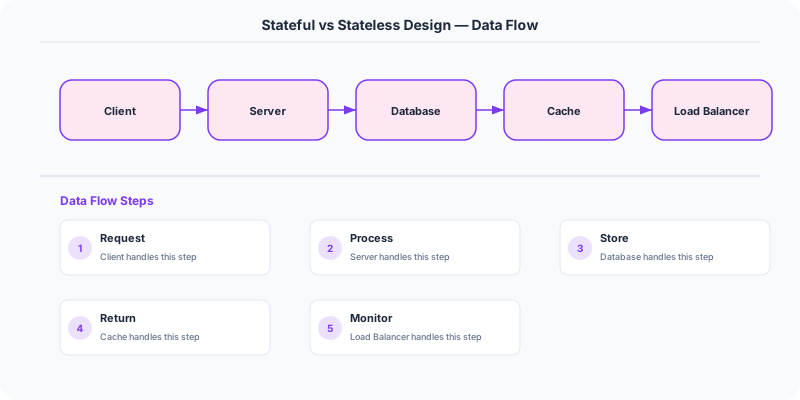
Default to stateless design in interviews — it is easier to scale. Use stateful only when the use case requires it (real-time features, caching). Always explain how you would handle failover for stateful components.
Source | System-Design-Overview
Real-World Decision Framework
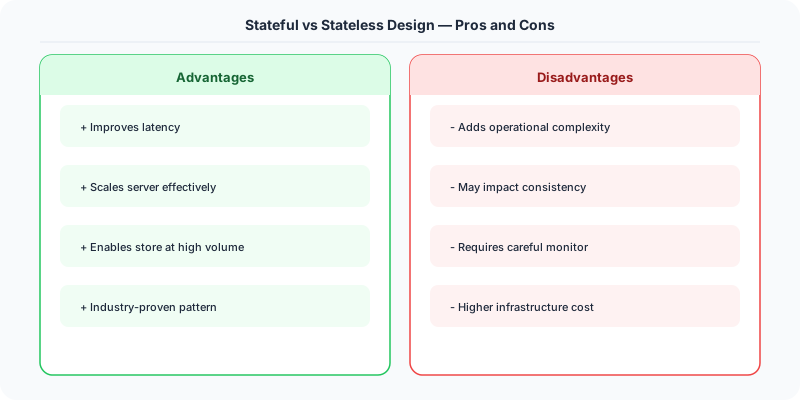
A stateless service treats every request independently — it stores no session data between requests. A stateful service remembers information from previous interactions. This distinction is one of the most important architectural decisions in distributed systems.
When Stateless Wins
Stateless is the default for most web services because it enables horizontal scaling:
- REST APIs: Each request carries all necessary information (auth token, parameters). The server needs no memory of previous requests.
- Microservices: Each service instance is interchangeable. A load balancer can route any request to any instance.
- Serverless functions: AWS Lambda and Azure Functions are inherently stateless — they spin up, handle a request, and shut down.
- CDN edge nodes: Every CDN node can serve any request without knowing what the user did previously.
Benefits: Easy scaling (add more instances), simple deployment (no state to migrate), fault tolerance (any instance dies, others continue).
When Stateful Wins
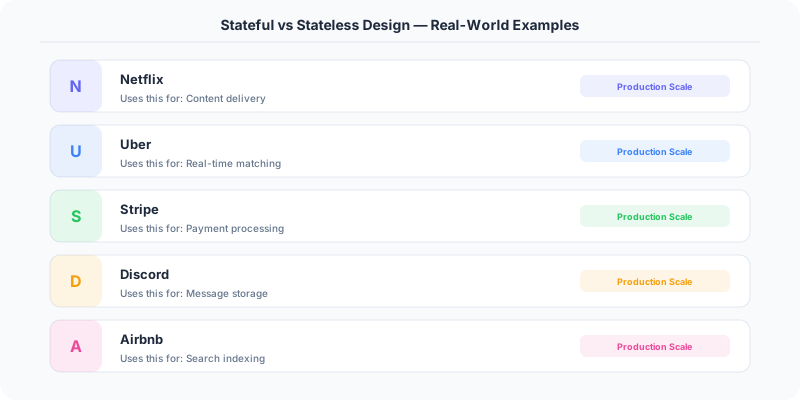
Some workloads inherently require state:
- WebSocket connections: Chat servers maintain a persistent connection and track which user is connected to which server.
- Gaming servers: A multiplayer game server tracks player positions, health, and inventory in memory.
- Database connections: Connection pools maintain authenticated, reusable database connections.
- Shopping carts: Some e-commerce systems store cart state server-side for cross-device consistency.
- Workflow engines: Long-running business processes (order fulfillment, loan approval) track state across multiple steps.
Technologies: Actor frameworks (Akka, Orleans), stateful containers (Kubernetes StatefulSets), Redis for externalized state.
The Real Pattern: Externalize State
The industry best practice is to build stateless services that externalize their state to a shared store. Your application servers are stateless, but they read/write session data from Redis, user data from a database, and cache data from Memcached. This gives you the scalability of stateless with the functionality of stateful.
Interview Framework
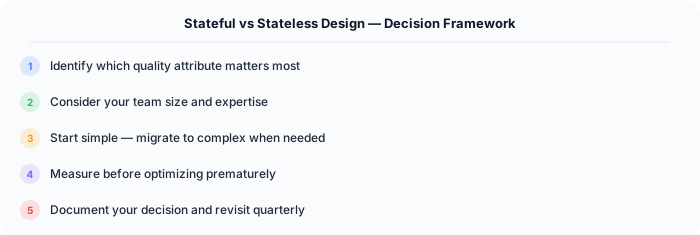
- Can state live externally? Yes → stateless service + external store (Redis, DB). No → stateful.
- Do you need horizontal scaling? Yes → stateless. Limited scaling OK → stateful is simpler.
- Is the state temporary? Session data → externalize to Redis with TTL. Persistent data → database.
.NET Implementation
Stateless: ASP.NET Core with AddStackExchangeRedisCache() for distributed session. Stateful: Use Microsoft Orleans for virtual actor-based stateful services, or Dapr for state management in Kubernetes. Use IDistributedCache interface to abstract the state store.
Original DosiBridge notes for Stateful vs Stateless Design
This section is written specifically for this page, not copied from a general system-design checklist. The useful way to study Stateful vs Stateless Design is to connect the concept to a production service where growth exposes the first weak assumption in the original design. That framing changes the design discussion from definitions to operating choices.
What makes this topic distinct
- Decision Boundary: For Stateful vs Stateless Design, decide the decision boundary before choosing tools; otherwise the design looks clean but fails when stateful changes.
- Reversal Cost: For Stateful vs Stateless Design, decide the reversal cost before choosing tools; otherwise the design looks clean but fails when vs changes.
- Operating Cost: For Stateful vs Stateless Design, decide the operating cost before choosing tools; otherwise the design looks clean but fails when stateless changes.
- Team Maturity: For Stateful vs Stateless Design, decide the team maturity before choosing tools; otherwise the design looks clean but fails when stateful changes.
- Growth Trigger: For Stateful vs Stateless Design, decide the growth trigger before choosing tools; otherwise the design looks clean but fails when vs changes.
Production review question
If a team adopts Stateful vs Stateless Design, what observable signal proves it helped instead of only making the architecture diagram more fashionable?
Practical metric to track
Track stateful-stateless health as a named dashboard or review item: combine one user-facing metric, one saturation metric, and one correctness metric. For Stateful vs Stateless Design, this keeps the discussion grounded in behavior that can be measured after deployment instead of generic advice that sounds good in an interview but never gets verified.