Concurrency vs Parallelism
Concurrency is dealing with multiple tasks at once (interleaving). Parallelism is doing multiple tasks at once (simultaneously).
Quick answer: Concurrency vs Parallelism
Concurrency vs Parallelism is covered here as a practical architecture tradeoff. Concurrency is dealing with multiple tasks at once (interleaving). Parallelism is doing multiple tasks at once (simultaneously). Use it when comparing two architecture choices and explaining the operational cost, latency, reliability, and team-complexity impact of each option.
Focus on the problem being solved, the main design choice, the failure mode, and the tradeoff you would defend in front of a senior engineer. This page is part of the DosiBridge system design knowledge graph, so it links related concepts, interview problems, tradeoffs, and references instead of leaving the topic isolated.
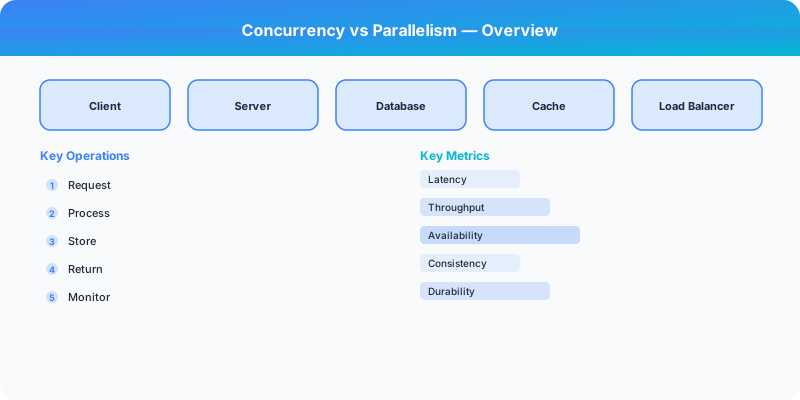
The Tradeoff
Concurrency is dealing with multiple tasks at once (interleaving). Parallelism is doing multiple tasks at once (simultaneously). Concurrency is about structure; parallelism is about execution.
Concurrency: A Closer Look
Multiple tasks make progress by interleaving execution on one or few cores. Async I/O, event loops, coroutines.
The Good
- Works on single-core machines
- Lower resource usage
- Good for I/O-bound workloads
- Simpler memory model (no shared state issues)
The Bad
- Does not speed up CPU-bound work
- Requires async programming model
- Callback hell or complex async patterns
Parallelism: A Closer Look
Multiple tasks execute simultaneously on multiple CPU cores. Threads, processes, SIMD.
The Good
- Speeds up CPU-bound work linearly with cores
- True simultaneous execution
- Leverages multi-core hardware
The Bad
- Race conditions and deadlocks
- Shared memory complexity
- Diminishing returns (Amdahl's Law)
- Higher memory usage
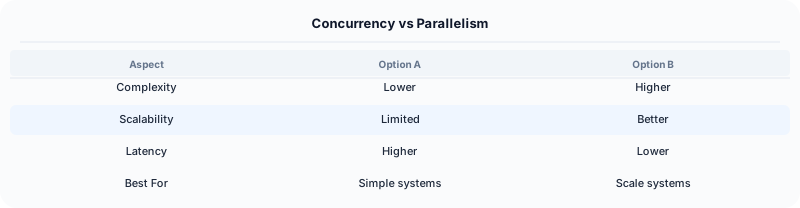
Quick Comparison
| Concurrency | Parallelism | |
|---|---|---|
| Best for | Workload is I/O-bound (database queries, HTTP calls, file reads) | Workload is CPU-bound (data processing, ML training, video encoding) |
Real-World Examples
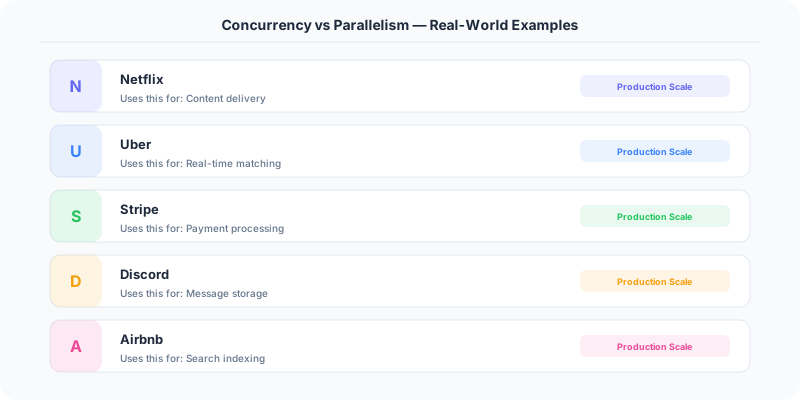
Node.js is concurrent but single-threaded — it handles thousands of connections by interleaving I/O operations on one core.
Apache Spark is parallel — it distributes data processing across hundreds of CPU cores on multiple machines.
Go combines both — goroutines provide concurrency (millions of lightweight threads) that the Go runtime schedules across all available CPU cores (parallelism).
Interview Advice
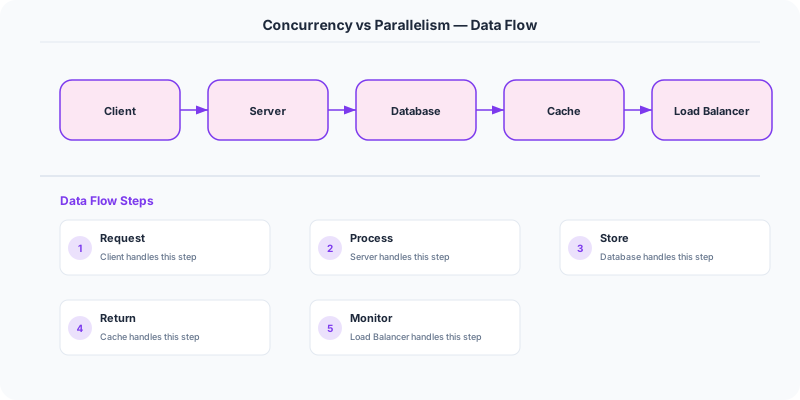
Know the difference: 'Concurrency is about dealing with lots of things at once. Parallelism is about doing lots of things at once.' — Rob Pike. Web servers need concurrency (I/O-bound). Data pipelines need parallelism (CPU-bound).
Source | System-Design-Overview
Real-World Decision Framework
Concurrency is about dealing with multiple tasks at once — managing their interleaving. Parallelism is about doing multiple tasks simultaneously on multiple cores. They are related but fundamentally different concepts.
Concurrency: Managing Multiple Tasks
Concurrency is a design pattern. A single-threaded Node.js server is concurrent but not parallel — it handles thousands of requests by switching between them using the event loop, but only one executes at a time.
Examples of concurrency:
- Web servers: Handle 10,000 simultaneous connections on a single thread using async I/O.
- GUI applications: Respond to user clicks while downloading a file in the background.
- Database connections: A connection pool manages 100 connections, allocating them to requests as needed.
- Operating systems: Run 200 processes on 8 cores by rapidly switching between them.
Parallelism: Doing Multiple Tasks Simultaneously
Parallelism is an execution strategy. It requires multiple CPUs or cores. A map-reduce job processing 1TB of data across 100 machines is parallel.
Examples of parallelism:
- Image processing: Apply a filter to each pixel simultaneously across 16 cores.
- Data pipelines: Process different data partitions on different machines simultaneously.
- Machine learning training: Train a model across 8 GPUs, each processing a different batch of data.
- Video encoding: Encode different frames of a video on different CPU cores simultaneously.
The Relationship
All parallel programs are concurrent (they manage multiple tasks), but not all concurrent programs are parallel (they might interleave on one core). A web server handling 10,000 connections is concurrent. A Spark job processing data across 100 nodes is both concurrent and parallel.
Why This Matters in System Design
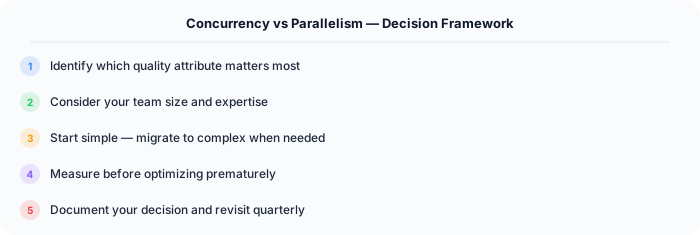
In interviews, this distinction helps you make architecture decisions:
- I/O-bound workloads (API calls, database queries, file reads): Use concurrency with async/await. Adding more cores does not help if the bottleneck is waiting for network responses.
- CPU-bound workloads (encryption, compression, ML inference): Use parallelism. More cores directly increase throughput.
- Mixed workloads: Use both — async for I/O, parallel workers for CPU-intensive tasks.
.NET Implementation
Concurrency: Use async/await throughout ASP.NET Core — the runtime multiplexes thousands of requests across a thread pool. Parallelism: Use Parallel.ForEachAsync(), PLINQ, or Task.WhenAll() for CPU-bound work. Use System.Threading.Channels for producer-consumer patterns that combine both.
Original DosiBridge notes for Concurrency vs Parallelism
This section is written specifically for this page, not copied from a general system-design checklist. The useful way to study Concurrency vs Parallelism is to connect the concept to a production service where growth exposes the first weak assumption in the original design. That framing changes the design discussion from definitions to operating choices.
What makes this topic distinct
- Decision Boundary: For Concurrency vs Parallelism, decide the decision boundary before choosing tools; otherwise the design looks clean but fails when concurrency changes.
- Reversal Cost: For Concurrency vs Parallelism, decide the reversal cost before choosing tools; otherwise the design looks clean but fails when vs changes.
- Operating Cost: For Concurrency vs Parallelism, decide the operating cost before choosing tools; otherwise the design looks clean but fails when parallelism changes.
- Team Maturity: For Concurrency vs Parallelism, decide the team maturity before choosing tools; otherwise the design looks clean but fails when concurrency changes.
- Growth Trigger: For Concurrency vs Parallelism, decide the growth trigger before choosing tools; otherwise the design looks clean but fails when vs changes.
Production review question
If a team adopts Concurrency vs Parallelism, what observable signal proves it helped instead of only making the architecture diagram more fashionable?
Practical metric to track
Track concurrency-parallelism health as a named dashboard or review item: combine one user-facing metric, one saturation metric, and one correctness metric. For Concurrency vs Parallelism, this keeps the discussion grounded in behavior that can be measured after deployment instead of generic advice that sounds good in an interview but never gets verified.