Designing Stripe's Payments API for 10 Years of Evolution
How Stripe designed an API that evolved over a decade while maintaining backward compatibility — versioning strategies, error conventions, and design.
Quick answer: Designing Stripe's Payments API for 10 Years of Evolution
Designing Stripe's Payments API for 10 Years of Evolution is covered here as a practical system design resource. How Stripe designed an API that evolved over a decade while maintaining backward compatibility — versioning strategies, error conventions, and design. Use it as a curated reference while connecting the original engineering lesson to practical system design decisions.
Focus on the problem being solved, the main design choice, the failure mode, and the tradeoff you would defend in front of a senior engineer. This page is part of the DosiBridge system design knowledge graph, so it links related concepts, interview problems, tradeoffs, and references instead of leaving the topic isolated.
Company Context
Stripe provides payment infrastructure for millions of businesses. Its REST API is the primary interface — every Stripe integration, from a one-person startup to a Fortune 500 company, depends on the API behaving predictably. Unlike internal APIs where you can coordinate breaking changes, a public API used by millions of integrations must evolve without breaking existing clients. A single breaking change could cause payment failures across thousands of businesses simultaneously.
The Problem at Scale
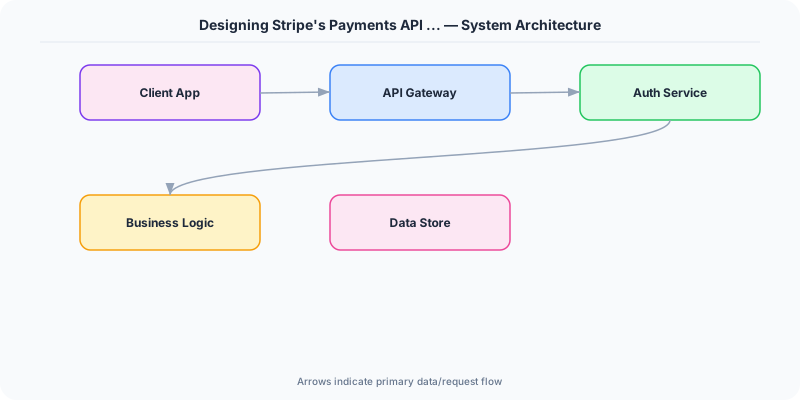
APIs must evolve — new features, better error messages, improved resource structures — but every change risks breaking integrations that depend on exact response shapes. Stripe needed a system that lets them improve the API continuously while ensuring that a merchant who integrated five years ago can still process payments without code changes. Semantic versioning alone is insufficient because even "minor" changes (adding a field, renaming an enum value) can break brittle client code.
Architecture Solution
Stripe's core innovation is API version pinning with automatic migration. Every Stripe account is pinned to the API version that existed when the account was created. When Stripe makes a change, they write a version change module that transforms the new internal representation into the shape expected by older versions. These modules chain together: a request from a client on version 2019-05-16 flows through every transformation between that version and the current internal version, like a series of adapters.
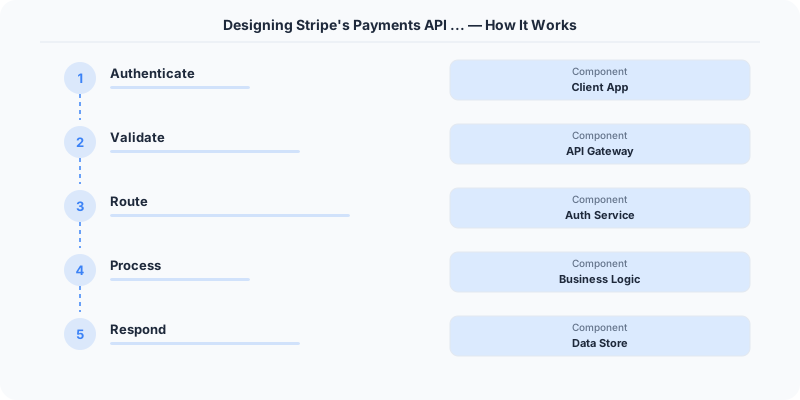
This means Stripe's internal systems only maintain one version of the code (the latest), while a cascade of lightweight transformation functions handle backward compatibility. New accounts automatically get the latest version, and existing accounts can upgrade at their own pace by testing against the new version in Stripe's test mode.
Stripe also established rigorous API design conventions: consistent resource naming (plural nouns, nested resources), predictable pagination (cursor-based), structured error objects with machine-readable error codes alongside human-readable messages, and idempotency keys on every mutating endpoint. These conventions reduce the surface area for breaking changes because clients can rely on structural patterns.
Expanding objects allow clients to request related resources inline (e.g., expanding a payment intent's customer), avoiding the need for multiple API calls without permanently changing the response shape. This pattern lets Stripe add relations without breaking existing response structures.
Key Techniques Used
- Version pinning: Each account uses the API version from its creation date
- Version change modules: Lightweight transformers that adapt responses between versions
- One internal version: Engineering only maintains the latest code; transformers handle legacy
- Cursor-based pagination: Stable pagination even when underlying data changes
- Structured error codes: Machine-readable codes for programmatic handling, separate from messages
- Idempotency keys: Every mutating endpoint supports idempotent retries
- Expanding objects: Inline related resources without changing base response shape
- Test mode: Merchants test against new API versions without affecting production traffic
Lessons for System Design Interviews
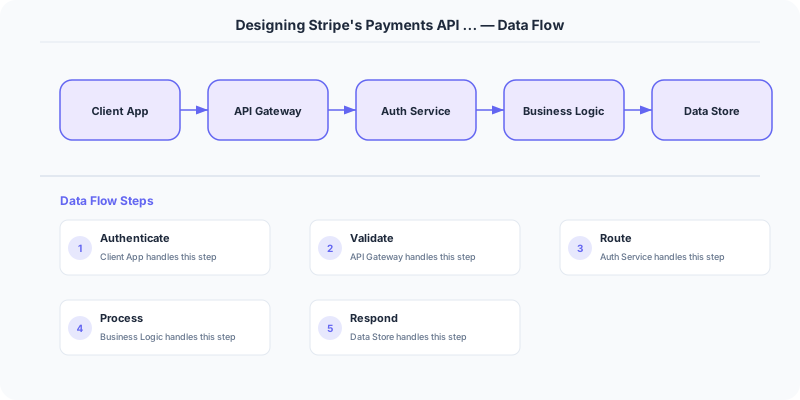
Reference Stripe's approach when discussing API design or evolution. Show awareness that versioning is not just a URL prefix (/v1/, /v2/) — it requires a strategy for transforming data between versions. Discuss the tradeoff between Stripe's per-account versioning (complex to implement, excellent developer experience) and URL-based versioning (simple but forces coordinated migration). Mention idempotency and structured errors as non-negotiable API design principles.
Lessons for Production
Design your API conventions before building the first endpoint — consistency is harder to retrofit than to establish. Version compatibility transformers are an investment that pays off at scale; without them, you either freeze your API or break clients. Always make mutating endpoints idempotent. Structured error responses with stable error codes are far more useful to integrators than freeform error messages. Invest in developer experience (documentation, test mode, client libraries) as a core product feature, not an afterthought.
Original DosiBridge notes for Designing Stripe's Payments API for 10 Years of Evolution
This section is written specifically for this page, not copied from a general system-design checklist. The useful way to study Designing Stripe's Payments API for 10 Years of Evolution is to connect the concept to an integration boundary where bad contracts become customer-facing outages. That framing changes the design discussion from definitions to operating choices.
What makes this topic distinct
- Practice Loop: For Designing Stripe's Payments API for 10 Years of Evolution, decide the practice loop before choosing tools; otherwise the design looks clean but fails when stripe changes.
- Implementation Exercise: For Designing Stripe's Payments API for 10 Years of Evolution, decide the implementation exercise before choosing tools; otherwise the design looks clean but fails when api changes.
- Review Checkpoint: For Designing Stripe's Payments API for 10 Years of Evolution, decide the review checkpoint before choosing tools; otherwise the design looks clean but fails when design changes.
- Failure Drill: For Designing Stripe's Payments API for 10 Years of Evolution, decide the failure drill before choosing tools; otherwise the design looks clean but fails when stripe changes.
- Comparison Target: For Designing Stripe's Payments API for 10 Years of Evolution, decide the comparison target before choosing tools; otherwise the design looks clean but fails when api changes.
Production review question
If a team adopts Designing Stripe's Payments API for 10 Years of Evolution, what observable signal proves it helped instead of only making the architecture diagram more fashionable?
Practical metric to track
Track stripe-design health as a named dashboard or review item: combine one user-facing metric, one saturation metric, and one correctness metric. For Designing Stripe's Payments API for 10 Years of Evolution, this keeps the discussion grounded in behavior that can be measured after deployment instead of generic advice that sounds good in an interview but never gets verified.