MapReduce: Simplified Data Processing on Large Clusters
Google's programming model for processing massive datasets in parallel across thousands of commodity machines — the paper that launched the big data era.
Quick answer: MapReduce: Simplified Data Processing on Large Clusters
MapReduce: Simplified Data Processing on Large Clusters is covered here as a practical system design resource. Google's programming model for processing massive datasets in parallel across thousands of commodity machines — the paper that launched the big data era. Use it as a curated reference while connecting the original engineering lesson to practical system design decisions.
Focus on the problem being solved, the main design choice, the failure mode, and the tradeoff you would defend in front of a senior engineer. This page is part of the DosiBridge system design knowledge graph, so it links related concepts, interview problems, tradeoffs, and references instead of leaving the topic isolated.
Historical Context
Published by Jeffrey Dean and Sanjay Ghemawat at Google in 2004 (OSDI), MapReduce was born from the observation that many of Google's internal computations — building search indexes, counting page hits, sorting logs — followed the same pattern: apply a function to each input record, then aggregate the results. Before MapReduce, engineers wrote ad-hoc distributed programs for each task, re-solving parallelism, fault tolerance, and data distribution every time.
Core Problem
How can engineers with no distributed-systems expertise process petabytes of data across thousands of unreliable commodity machines, without writing explicit networking, fault-recovery, or scheduling code?
Key Innovation
MapReduce abstracts parallel computation into two user-defined functions. The Map function takes an input key-value pair and emits intermediate key-value pairs. The framework groups all intermediate values by key (the "shuffle" step), then the Reduce function merges all values for each key into a final result.
The runtime handles everything else: splitting input data into 16-64 MB chunks, scheduling Map tasks close to the data on GFS, re-executing failed tasks on other machines, and writing output back to GFS. A single master node assigns work and tracks progress. If a worker dies, the master simply reassigns its tasks — since Map output is stored on local disk and Reduce output goes to GFS, recomputation is straightforward.
A key optimization is the combiner function, which performs a local partial reduce on each mapper before the shuffle, dramatically cutting network traffic. Another is locality-aware scheduling: the master prefers to run Map tasks on machines that already hold the relevant GFS chunk.
Architecture / Algorithm
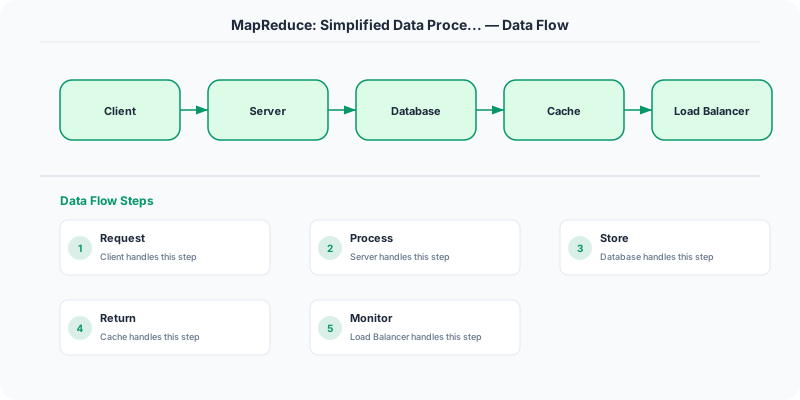
- Input Splitting: Data is divided into M splits, each processed by one Map task.
- Map Phase: Each mapper reads its split, applies the user Map function, and writes intermediate pairs to local disk, partitioned into R buckets.
- Shuffle Phase: Reducers pull their partition from every mapper via RPC, then sort by key.
- Reduce Phase: Each reducer iterates through sorted keys, calling the user Reduce function, and writes output to GFS.
- Master: Coordinates task assignment, monitors heartbeats, handles stragglers by launching backup tasks.
Strengths
- Radically simple programming model: users only write Map and Reduce
- Automatic fault tolerance through deterministic re-execution
- Scales linearly by adding commodity machines
- Backup tasks mitigate stragglers (slow machines)
Weaknesses
- High latency: each job reads from and writes to disk, making it unsuitable for interactive queries
- Rigid two-phase model: multi-stage pipelines require chaining multiple MapReduce jobs
- Single master is a potential bottleneck for very large clusters
- Superseded by more flexible frameworks (Spark, Flink, Dataflow) that support in-memory processing and DAG execution
Modern Systems Influenced
Apache Hadoop is a direct open-source reimplementation. Spark replaced MapReduce's disk-heavy model with in-memory RDDs. Google Cloud Dataflow and Apache Beam generalized the model into streaming/batch pipelines. The map-shuffle-reduce pattern remains fundamental to every distributed data processing framework.
Interview Relevance
MapReduce is a go-to reference when designing offline data pipelines, batch analytics, or log processing systems. Know how input splitting enables parallelism, why the shuffle phase is the bottleneck, and how fault tolerance works via re-execution. Compare it with Spark's in-memory model when discussing latency-sensitive analytics.
Plain-English Summary
MapReduce lets you process huge datasets by breaking the work into two steps: Map applies a function to every record independently (fully parallel), then Reduce aggregates the results by key. The framework handles splitting data, scheduling work, and retrying failures. You write two small functions; the system handles the distributed computing.
Original DosiBridge notes for MapReduce: Simplified Data Processing on Large Clusters
This section is written specifically for this page, not copied from a general system-design checklist. The useful way to study MapReduce: Simplified Data Processing on Large Clusters is to connect the concept to a production service where growth exposes the first weak assumption in the original design. That framing changes the design discussion from definitions to operating choices.
What makes this topic distinct
- Practice Loop: For MapReduce: Simplified Data Processing on Large Clusters, decide the practice loop before choosing tools; otherwise the design looks clean but fails when mapreduce changes.
- Implementation Exercise: For MapReduce: Simplified Data Processing on Large Clusters, decide the implementation exercise before choosing tools; otherwise the design looks clean but fails when mapreduce changes.
- Review Checkpoint: For MapReduce: Simplified Data Processing on Large Clusters, decide the review checkpoint before choosing tools; otherwise the design looks clean but fails when mapreduce changes.
- Failure Drill: For MapReduce: Simplified Data Processing on Large Clusters, decide the failure drill before choosing tools; otherwise the design looks clean but fails when mapreduce changes.
- Comparison Target: For MapReduce: Simplified Data Processing on Large Clusters, decide the comparison target before choosing tools; otherwise the design looks clean but fails when mapreduce changes.
Production review question
If a team adopts MapReduce: Simplified Data Processing on Large Clusters, what observable signal proves it helped instead of only making the architecture diagram more fashionable?
Practical metric to track
Track mapreduce health as a named dashboard or review item: combine one user-facing metric, one saturation metric, and one correctness metric. For MapReduce: Simplified Data Processing on Large Clusters, this keeps the discussion grounded in behavior that can be measured after deployment instead of generic advice that sounds good in an interview but never gets verified.