How Airbnb Avoids Double Payments in a Distributed System
Airbnb's idempotency framework for distributed payments — preventing double-charges across microservices with idempotency keys and state machines.
Quick answer: How Airbnb Avoids Double Payments in a Distributed System
How Airbnb Avoids Double Payments in a Distributed System is covered here as a practical system design resource. Airbnb's idempotency framework for distributed payments — preventing double-charges across microservices with idempotency keys and state machines. Use it as a curated reference while connecting the original engineering lesson to practical system design decisions.
Focus on the problem being solved, the main design choice, the failure mode, and the tradeoff you would defend in front of a senior engineer. This page is part of the DosiBridge system design knowledge graph, so it links related concepts, interview problems, tradeoffs, and references instead of leaving the topic isolated.
Company Context
Airbnb processes millions of financial transactions across a microservices architecture that spans multiple teams and systems. A single booking triggers a cascade of payment operations: charging the guest, holding funds in escrow, paying the host, calculating service fees, and handling taxes. Each operation crosses service boundaries, involves external payment processors, and must be exactly-once in effect — charging a guest twice is unacceptable, and failing to pay a host erodes trust.
The Problem at Scale
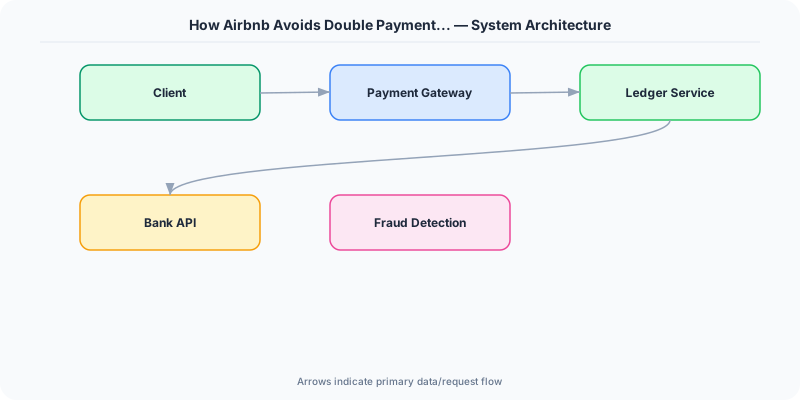
In a distributed system, any network call can fail, time out, or succeed without the caller knowing. When a payment service calls Stripe to charge a card and the connection drops after Stripe processes the charge but before the response arrives, the caller does not know if the charge went through. The naive retry — just try again — risks double-charging. Conversely, not retrying risks failing to process a legitimate payment. This problem compounds across a microservice graph where each service may independently retry, creating a combinatorial explosion of potential duplicate operations.
Architecture Solution
Airbnb built a generic idempotency framework that wraps every payment operation. Each API request carries an idempotency key — a client-generated unique identifier (typically a UUID) that represents a specific intended operation. The server stores the idempotency key and the result of the operation in a database. If the same key is received again, the server returns the stored result without re-executing the operation.
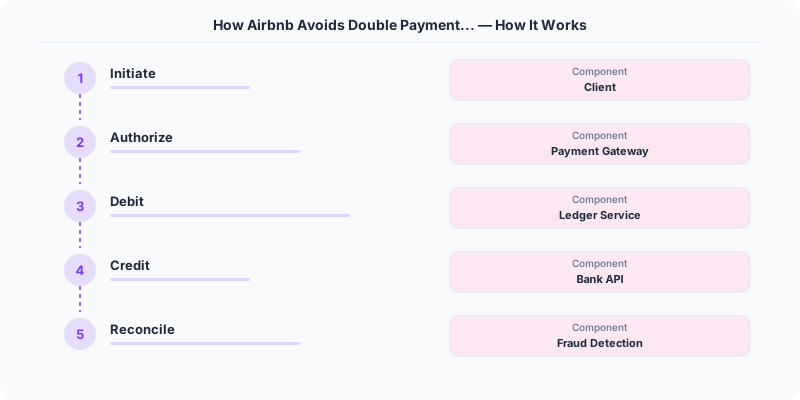
The framework models each payment operation as a state machine with well-defined states (CREATED, PROCESSING, SUCCEEDED, FAILED). The idempotency record stores the current state, and the server uses optimistic locking to transition between states. This prevents concurrent requests with the same key from both executing the operation.
For multi-step payment flows (charge guest, then pay host, then record fees), the framework uses a saga pattern: each step has a compensating action (refund guest, reverse host payout). If any step fails after previous steps succeeded, the compensating actions are executed to restore consistency. The idempotency framework ensures that both forward and compensating actions are individually idempotent.
The framework also handles the ambiguous failure case: when the result of an external call is unknown (timeout), the system records the state as UNKNOWN and uses a background reconciliation process to query the external provider and resolve the state.
Key Techniques Used
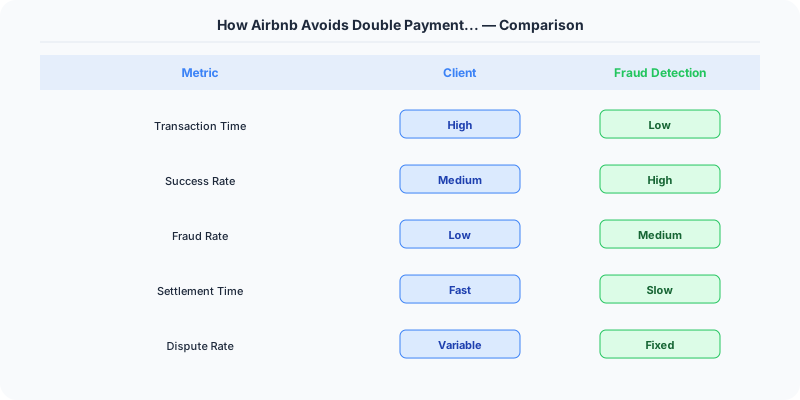
- Idempotency keys: Client-generated UUIDs attached to every payment request
- Server-side result caching: Store operation outcomes keyed by idempotency key
- State machine model: Each operation transitions through defined states with optimistic locking
- Saga pattern: Multi-step operations with compensating actions for rollback
- Background reconciliation: Resolve ambiguous failures by querying external providers
- Optimistic locking: Prevent concurrent duplicate execution of the same operation
Lessons for System Design Interviews
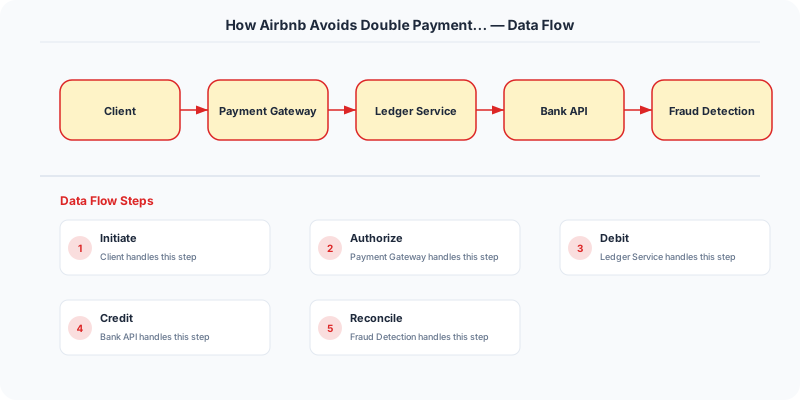
This case study is essential for any payment system design question. Demonstrate that you understand why "exactly-once" is impossible in distributed systems but "effectively-once" (idempotent retries) is achievable. Show the idempotency key pattern, explain why keys must be client-generated (not server-generated), and discuss the state machine approach. Mention the saga pattern for multi-step transactions as an alternative to distributed transactions.
Lessons for Production
Every API that has side effects (especially financial ones) should be idempotent. Idempotency keys must be stored durably before executing the operation — if the key store is in-memory, a server restart causes the protection to vanish. The "ambiguous failure" case (timeout on external call) is the hardest to handle correctly and requires background reconciliation. Design compensating actions from the start; retrofitting them is extremely difficult.
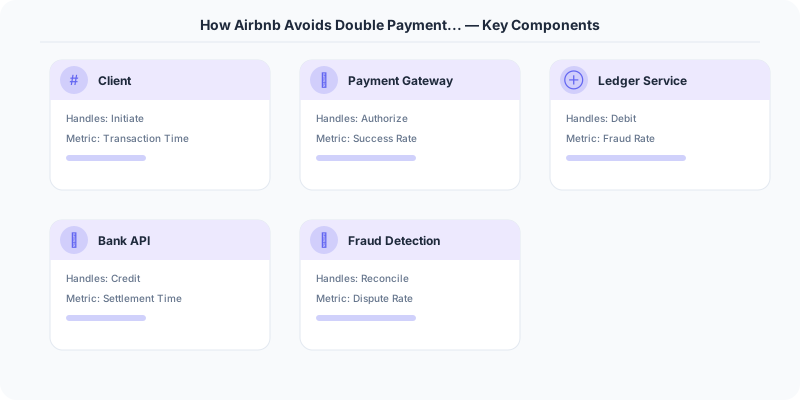
Original DosiBridge notes for How Airbnb Avoids Double Payments in a Distributed System
This section is written specifically for this page, not copied from a general system-design checklist. The useful way to study How Airbnb Avoids Double Payments in a Distributed System is to connect the concept to a scarce or money-moving workflow where duplicate writes and race conditions are more dangerous than slow responses. That framing changes the design discussion from definitions to operating choices.
What makes this topic distinct
- Practice Loop: For How Airbnb Avoids Double Payments in a Distributed System, decide the practice loop before choosing tools; otherwise the design looks clean but fails when airbnb changes.
- Implementation Exercise: For How Airbnb Avoids Double Payments in a Distributed System, decide the implementation exercise before choosing tools; otherwise the design looks clean but fails when payments changes.
- Review Checkpoint: For How Airbnb Avoids Double Payments in a Distributed System, decide the review checkpoint before choosing tools; otherwise the design looks clean but fails when airbnb changes.
- Failure Drill: For How Airbnb Avoids Double Payments in a Distributed System, decide the failure drill before choosing tools; otherwise the design looks clean but fails when payments changes.
- Comparison Target: For How Airbnb Avoids Double Payments in a Distributed System, decide the comparison target before choosing tools; otherwise the design looks clean but fails when airbnb changes.
Production review question
If a team adopts How Airbnb Avoids Double Payments in a Distributed System, what observable signal proves it helped instead of only making the architecture diagram more fashionable?
Practical metric to track
Track airbnb-payments health as a named dashboard or review item: combine one user-facing metric, one saturation metric, and one correctness metric. For How Airbnb Avoids Double Payments in a Distributed System, this keeps the discussion grounded in behavior that can be measured after deployment instead of generic advice that sounds good in an interview but never gets verified.