Design Distributed Key-Value Store
System design interview solution for Design Distributed Key-Value Store. Includes requirements, API design, data model, architecture, scaling strategy,.
Quick answer: Design Distributed Key-Value Store
Design Distributed Key-Value Store is covered here as a practical system design interview problem. System design interview solution for Design Distributed Key-Value Store. Includes requirements, API design, data model, architecture, scaling strategy,. Use it to practice requirements, APIs, storage choices, scaling bottlenecks, data consistency, observability, and failure handling for a easy interview round.
Focus on the problem being solved, the main design choice, the failure mode, and the tradeoff you would defend in front of a senior engineer. This page is part of the DosiBridge system design knowledge graph, so it links related concepts, interview problems, tradeoffs, and references instead of leaving the topic isolated.
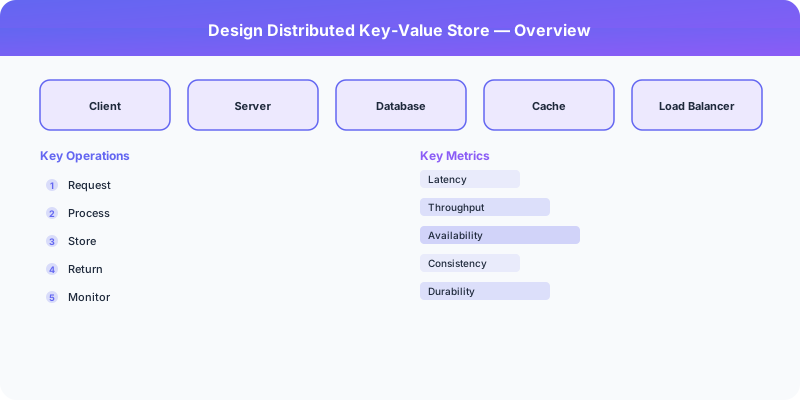
Problem Statement
Design Distributed Key-Value Store as a production service where growth exposes the first weak assumption in the original design. For Design Distributed Key-Value Store, name the critical user action, the data that must remain correct, and the first bottleneck that appears when traffic grows.
Original DosiBridge notes for Design Distributed Key-Value Store
This section is written specifically for this page, not copied from a general system-design checklist. The useful way to study Design Distributed Key-Value Store is to connect the concept to a production service where growth exposes the first weak assumption in the original design. That framing changes the design discussion from definitions to operating choices.
What makes this topic distinct
- Core Entity: For Design Distributed Key-Value Store, decide the core entity before choosing tools; otherwise the design looks clean but fails when distributed changes.
- Read/Write Path: For Design Distributed Key-Value Store, decide the read/write path before choosing tools; otherwise the design looks clean but fails when kv changes.
- Contention Point: For Design Distributed Key-Value Store, decide the contention point before choosing tools; otherwise the design looks clean but fails when store changes.
- Abuse Path: For Design Distributed Key-Value Store, decide the abuse path before choosing tools; otherwise the design looks clean but fails when distributed changes.
- Recovery Workflow: For Design Distributed Key-Value Store, decide the recovery workflow before choosing tools; otherwise the design looks clean but fails when kv changes.
Design Distributed Key-Value Store correctness boundary
For this problem, separate the user-visible action from background work. The correctness boundary is the smallest state transition that must not be duplicated, lost, or reordered. Naming that boundary makes the solution more original than a stock API/database/cache template.
Design Distributed Key-Value Store scaling bottleneck
The first bottleneck should be described in the language of this system: a hot timeline, a contested seat, a busy wallet ledger, a media-processing queue, or a search index update delay. That bottleneck decides which component deserves the deepest interview discussion.
Production review question
If Design Distributed Key-Value Store suddenly receives 10x traffic, which entity becomes contested first, and what queue, lock, shard, or cache protects that entity without hiding correctness bugs?
Practical metric to track
Track distributed-store health as a named dashboard or review item: combine one user-facing metric, one saturation metric, and one correctness metric. For Design Distributed Key-Value Store, this keeps the discussion grounded in behavior that can be measured after deployment instead of generic advice that sounds good in an interview but never gets verified.
Sources
Differentiation note: this problem is about storage semantics
This key-value store problem is intentionally different from the Google Docs collaboration problem. Here the core challenge is providing simple get/put/delete semantics across partitions, replicas, and failures. There are no collaborative cursors, document operations, comments, or rich text merges.
Storage-specific decisions
- Choose key partitioning with consistent hashing or range partitioning.
- Replicate each partition to multiple nodes for availability.
- Decide between strong reads from a leader and eventually consistent reads from replicas.
- Use quorum reads/writes when tunable consistency is required.
- Add hinted handoff, read repair, or anti-entropy for replica healing.
- Store values in an LSM-tree or similar write-optimized engine when write volume is high.
Example operation flow
For 'put(user:123, value)', the coordinator hashes the key to a partition, forwards the write to replica nodes, waits for the configured write quorum, and returns success. If one replica is down, the system may store a hinted write and repair the replica later. For 'get(user:123)', the coordinator reads from one or more replicas, resolves versions if needed, and returns the latest acceptable value.
Interview tradeoff
The strongest answer defines the consistency contract first. A cache-like KV store can accept eventual consistency. A configuration or payment-state KV store may need stronger guarantees. The architecture follows that promise.