Bulkhead Pattern: Isolate Failures in Distributed Systems
Learn the Bulkhead Pattern for distributed systems: resource isolation, thread pools, connection pools, blast-radius control, and resilience tradeoffs.
Quick answer: Bulkhead Pattern: Isolate Failures in Distributed Systems
Bulkhead Pattern: Isolate Failures in Distributed Systems is covered here as a practical system design concept. Learn the Bulkhead Pattern for distributed systems: resource isolation, thread pools, connection pools, blast-radius control, and resilience tradeoffs. Use it to understand the Distributed Systems idea, where it appears in production systems, and how to discuss it clearly in interviews.
Focus on the problem being solved, the main design choice, the failure mode, and the tradeoff you would defend in front of a senior engineer. This page is part of the DosiBridge system design knowledge graph, so it links related concepts, interview problems, tradeoffs, and references instead of leaving the topic isolated.
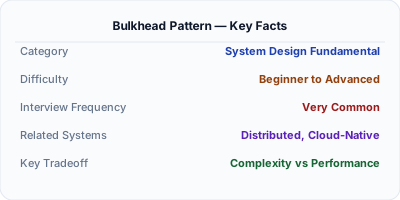
The Bulkhead Pattern isolates components of a distributed system into independent pools so that a failure in one cannot cascade and bring down others. Named after the watertight compartments in a ship's hull, bulkheads partition thread pools, connection pools, or entire service instances. If one partition fails or becomes overloaded, the others continue operating normally. This is a foundational resilience pattern for any microservices architecture handling diverse workloads.
| Aspect | Details |
|---|---|
| What it is | A fault-isolation technique that partitions resources into independent pools to prevent cascading failures |
| When to use | When services share thread pools, connection pools, or downstream dependencies that could cause total outages |
| When NOT to use | When system has a single responsibility with uniform load and adding partitions would add unnecessary complexity |
| Real-world example | Netflix isolates thread pools per downstream dependency so a slow recommendations service cannot starve the playback service |
| Interview tip | Explain bulkheads alongside circuit breakers — they complement each other; bulkheads isolate, circuit breakers cut off |
| Common mistake | Using a single shared thread pool for all downstream calls — one slow dependency exhausts all threads |
| Key tradeoff | Resource utilization vs. isolation — more bulkheads mean better isolation but lower overall resource efficiency |
Why This Matters
In a microservices architecture, services share resources like thread pools, connection pools, and CPU. Without isolation, a single slow or failing dependency can exhaust shared resources, causing a cascading failure that takes down the entire system. The Bulkhead Pattern prevents this by assigning dedicated resource pools to each dependency or workload class. Even if one pool is completely saturated, the others remain unaffected. This is especially critical for systems handling mixed priority traffic — you can ensure critical payment flows never compete with low-priority analytics calls for the same resources.
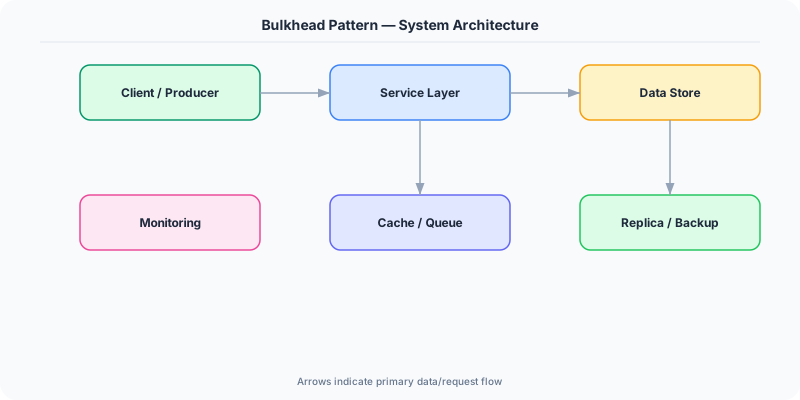
The Building Blocks
- Resource Pools: Dedicated thread pools, connection pools, or semaphores assigned to each dependency or workload category
- Partition Strategy: The decision of how to divide resources — by downstream service, by criticality tier, or by customer segment
- Pool Sizing: Configuring max concurrency per partition based on expected load and acceptable degradation thresholds
- Rejection Policy: What happens when a bulkhead pool is exhausted — fast-fail, queue briefly, or shed load to protect the system
- Health Monitoring: Tracking pool utilization and rejection rates per bulkhead to detect saturation before it causes user-visible failures
Under the Hood
The Bulkhead Pattern works by creating isolated execution contexts for different categories of work. In a typical implementation, each downstream service call gets its own thread pool or semaphore with a fixed maximum concurrency. When service A's pool has 20 threads and service B's pool has 10 threads, a surge of slow responses from service B can only block those 10 threads — the 20 threads for service A remain available.
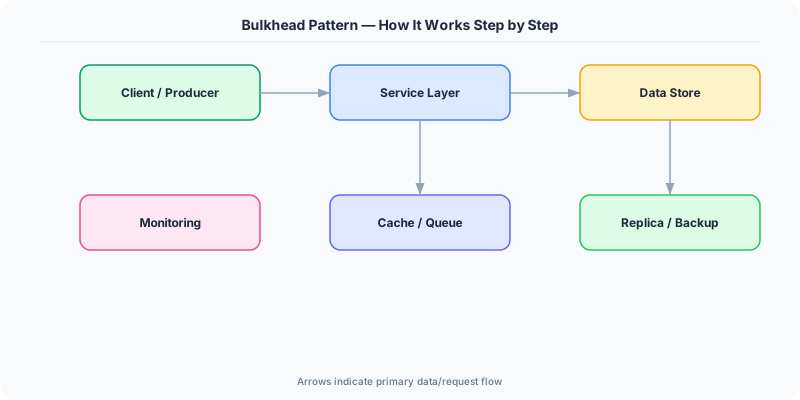
There are two primary implementation approaches: thread pool isolation and semaphore isolation. Thread pool isolation provides true separation with dedicated threads and supports timeouts on the calling thread, but introduces context-switching overhead. Semaphore isolation uses lightweight counters to limit concurrent access — it is faster but the calling thread blocks if the downstream call is slow.
More advanced bulkhead implementations partition at the infrastructure level. Kubernetes allows assigning pods to different node pools, so a misbehaving service's resource consumption is physically capped. Service meshes like Istio can enforce connection limits per destination. The key design decision is granularity: too few bulkheads provide insufficient isolation, while too many waste resources sitting idle in underutilized pools.
How Companies Actually Do This
Netflix Uses Hystrix thread pool isolation to assign each downstream microservice its own bulkhead, preventing a slow recommendation engine from blocking video playback API calls
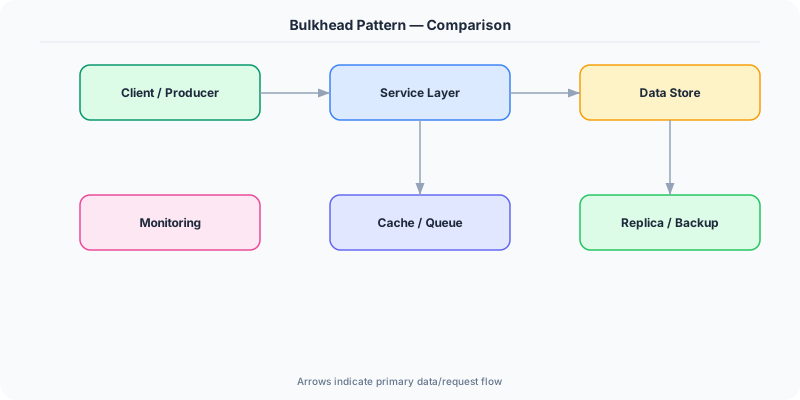
Amazon Partitions services into cells (a form of bulkhead) so that failures in one cell only affect a fraction of customers, not the entire fleet
Spotify Isolates backend service pools per feature domain so that a failing podcast metadata service cannot impact music streaming or search functionality
Common Pitfalls
- Sizing pools too small causes premature rejection of requests even under normal load — always benchmark pool sizes against expected p99 traffic
- Over-partitioning resources leads to low overall utilization because idle capacity in one bulkhead cannot help an overloaded neighbor
- Forgetting to add bulkheads to async or reactive pipelines — isolation only works if every execution path enforces it, including background jobs and event handlers
Interview Questions Worth Practicing
- How do you decide the number and size of bulkhead partitions for a new microservice?
- What is the difference between thread pool isolation and semaphore isolation in the Bulkhead Pattern?
- How do bulkheads interact with circuit breakers and retry policies in a resilience stack?
The Tradeoffs
- Isolation vs. Utilization: More bulkheads provide stronger fault isolation but reduce overall resource efficiency since idle pools cannot share capacity
- Granularity vs. Complexity: Fine-grained per-dependency bulkheads give precise control but increase configuration burden and monitoring surface area
- Thread Pool vs. Semaphore: Thread pools offer true isolation with timeouts but add overhead; semaphores are lightweight but block the calling thread
How to Explain This in an Interview
Here is how I would explain Bulkhead Pattern in a system design interview:
The Bulkhead Pattern isolates system components into independent resource pools to prevent cascading failures. Named after ship compartments, if one fills with water the others stay dry. In practice, you assign separate thread pools or semaphores to each downstream dependency. If the recommendation service becomes slow and saturates its pool of 15 threads, your payment service pool of 20 threads is completely unaffected. I would pair bulkheads with circuit breakers — bulkheads contain the blast radius while circuit breakers cut off failing calls entirely. The key tradeoff is isolation strength versus resource utilization, since idle capacity in one pool cannot help another.
Related Topics
Original DosiBridge notes for Bulkhead Pattern: Isolate Failures in Distributed Systems
This section is written specifically for this page, not copied from a general system-design checklist. The useful way to study Bulkhead Pattern: Isolate Failures in Distributed Systems is to connect the concept to a production service where growth exposes the first weak assumption in the original design. That framing changes the design discussion from definitions to operating choices.
What makes this topic distinct
- Membership: For Bulkhead Pattern: Isolate Failures in Distributed Systems, decide the membership before choosing tools; otherwise the design looks clean but fails when bulkhead changes.
- Clock Drift: For Bulkhead Pattern: Isolate Failures in Distributed Systems, decide the clock drift before choosing tools; otherwise the design looks clean but fails when pattern changes.
- Retry Semantics: For Bulkhead Pattern: Isolate Failures in Distributed Systems, decide the retry semantics before choosing tools; otherwise the design looks clean but fails when bulkhead changes.
- Partition Behavior: For Bulkhead Pattern: Isolate Failures in Distributed Systems, decide the partition behavior before choosing tools; otherwise the design looks clean but fails when pattern changes.
- Reconciliation: For Bulkhead Pattern: Isolate Failures in Distributed Systems, decide the reconciliation before choosing tools; otherwise the design looks clean but fails when bulkhead changes.
Production review question
If a team adopts Bulkhead Pattern: Isolate Failures in Distributed Systems, what observable signal proves it helped instead of only making the architecture diagram more fashionable?
Practical metric to track
Track bulkhead-pattern health as a named dashboard or review item: combine one user-facing metric, one saturation metric, and one correctness metric. For Bulkhead Pattern: Isolate Failures in Distributed Systems, this keeps the discussion grounded in behavior that can be measured after deployment instead of generic advice that sounds good in an interview but never gets verified.