How Netflix Serves 200 Million Subscribers
Quick answer: How Netflix Serves 200 Million Subscribers
How Netflix Serves 200 Million Subscribers is covered here as a practical system design article. A deep dive into Netflix's architecture — microservices, Open Connect CDN, adaptive bitrate streaming, and chaos engineering practices that serve 15% of. Use it to turn a broad system design idea into an interview-ready checklist with practical examples and links to deeper topics.
Focus on the problem being solved, the main design choice, the failure mode, and the tradeoff you would defend in front of a senior engineer. This page is part of the DosiBridge system design knowledge graph, so it links related concepts, interview problems, tradeoffs, and references instead of leaving the topic isolated.
How Netflix Serves 200 Million Subscribers
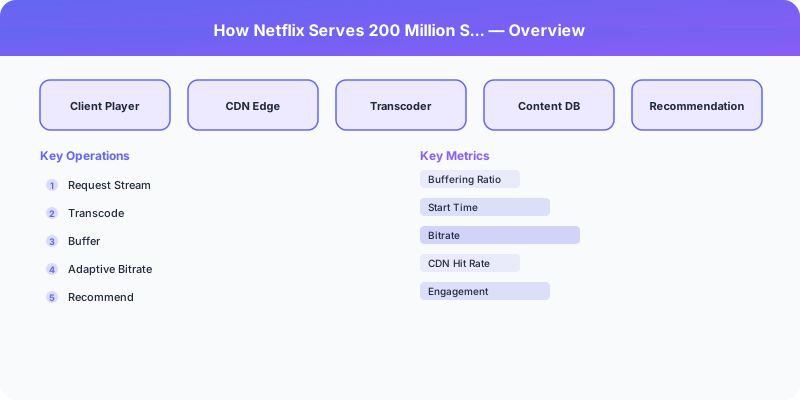
Netflix accounts for roughly 15% of all internet downstream traffic globally. Serving 200M+ subscribers across 190 countries requires an architecture that is resilient, globally distributed, and optimized for the viewing experience.
The Architecture Stack
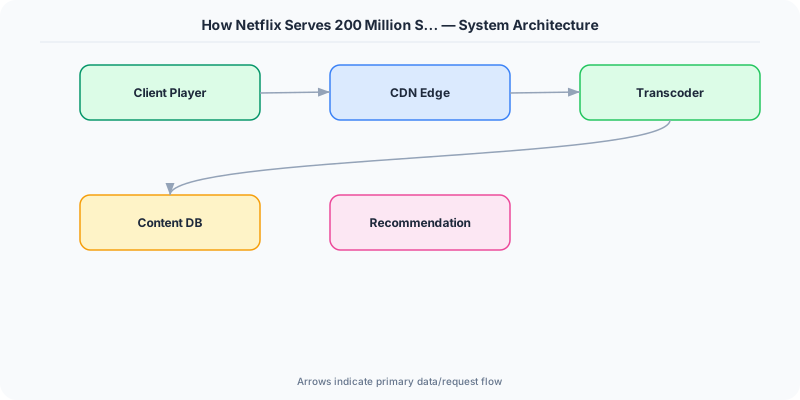
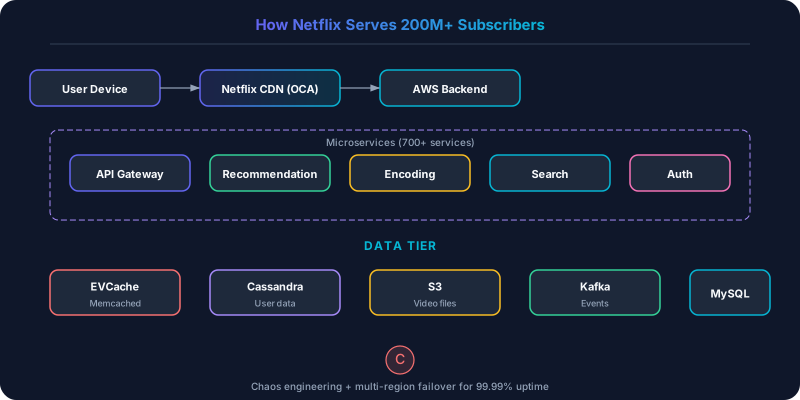
Netflix runs entirely on AWS for its control plane (user authentication, recommendations, billing, content catalog) but uses its own CDN — Open Connect — for the actual video delivery.
Open Connect: Netflix's CDN
Instead of paying Akamai or CloudFront, Netflix built Open Connect — a network of servers placed directly inside ISP networks worldwide. When you watch Netflix, the video streams from a server physically located in your ISP's data center, not from a remote AWS region.
How it works:
- During off-peak hours, Netflix pushes popular content to Open Connect Appliances (OCAs) at ISP locations
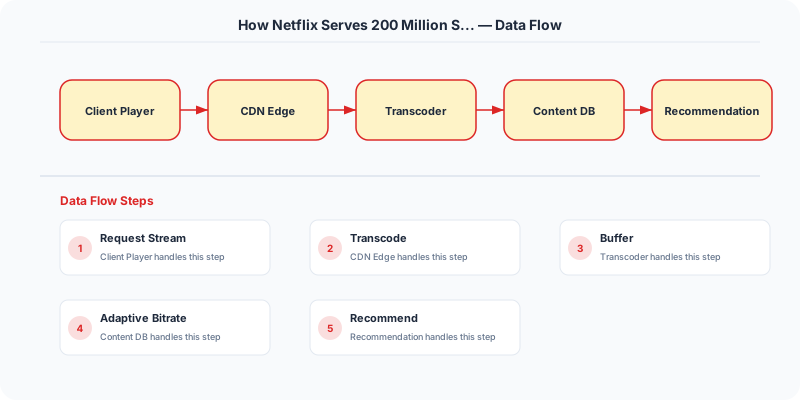
- When you press play, the Netflix control plane (running on AWS) determines which OCA has the content closest to you
- Your player connects directly to the OCA and streams via HTTP
- If the closest OCA is overloaded, traffic spills to the next closest
This reduces Netflix's bandwidth costs, reduces latency for viewers, and reduces internet backbone congestion for ISPs — a win for everyone.
Microservices Architecture
Netflix runs 1,000+ microservices on AWS. Each team owns their service end-to-end (build, deploy, operate). Key services:
- API Gateway (Zuul): Routes all client requests, handles authentication, rate limiting, and load shedding
- Discovery (Eureka): Service registry — every microservice registers itself and discovers others
- Resilience (Hystrix/resilience4j): Circuit breakers prevent cascading failures across services
- Content Service: Manages the catalog — 15,000+ titles with metadata in multiple languages
- Recommendation Service: ML models trained on viewing history, generating personalized rankings
Adaptive Bitrate Streaming
Netflix encodes each title in 10+ quality levels (from 240p to 4K HDR) and multiple codecs (H.264, VP9, AV1). The player continuously monitors bandwidth and switches quality seamlessly:
- Connection drops to 3G? Switch to 480p within 4 seconds
- WiFi recovered? Gradually step up to 1080p
- Each "chunk" (4-second segment) can be a different quality
AV1 codec delivers 20% better compression than VP9, saving Netflix $1B+ annually in bandwidth.
Chaos Engineering
Netflix invented chaos engineering — deliberately injecting failures in production to build confidence in system resilience:
- Chaos Monkey: Randomly kills EC2 instances
- Chaos Kong: Simulates an entire AWS region failure
- Latency Monkey: Introduces artificial delays between services
The philosophy: if a system has not been tested under failure, it will fail unpredictably when a real incident occurs.
Key Takeaways
- Own your CDN at scale: At Netflix's volume, a custom CDN is cheaper and better than third-party options
- Microservices enable team autonomy: 1,000+ services let 10,000+ engineers deploy independently
- Design for failure: Chaos engineering catches weaknesses before they cause outages
- Invest in encoding: Better codecs directly reduce infrastructure costs at scale
Original DosiBridge notes for How Netflix Serves 200 Million Subscribers
This section is written specifically for this page, not copied from a general system-design checklist. The useful way to study How Netflix Serves 200 Million Subscribers is to connect the concept to an asynchronous workflow where replay, ordering, and poison messages shape the architecture. That framing changes the design discussion from definitions to operating choices.
What makes this topic distinct
- Practical Lesson: For How Netflix Serves 200 Million Subscribers, decide the practical lesson before choosing tools; otherwise the design looks clean but fails when how changes.
- Migration Story: For How Netflix Serves 200 Million Subscribers, decide the migration story before choosing tools; otherwise the design looks clean but fails when netflix changes.
- Production Symptom: For How Netflix Serves 200 Million Subscribers, decide the production symptom before choosing tools; otherwise the design looks clean but fails when serves changes.
- Decision Checklist: For How Netflix Serves 200 Million Subscribers, decide the decision checklist before choosing tools; otherwise the design looks clean but fails when 200m changes.
- Rollback Plan: For How Netflix Serves 200 Million Subscribers, decide the rollback plan before choosing tools; otherwise the design looks clean but fails when subscribers changes.
Production review question
If a team adopts How Netflix Serves 200 Million Subscribers, what observable signal proves it helped instead of only making the architecture diagram more fashionable?
Practical metric to track
Track how-subscribers health as a named dashboard or review item: combine one user-facing metric, one saturation metric, and one correctness metric. For How Netflix Serves 200 Million Subscribers, this keeps the discussion grounded in behavior that can be measured after deployment instead of generic advice that sounds good in an interview but never gets verified.
Sources
- Netflix Tech Blog: netflixtechblog.com
- System-Design-Overview
Putting This Into Practice
Understanding the theory is only half the battle. Here is how to apply these concepts in your daily work:
Start small. Pick one project or one component of your current system and apply the ideas from this article. Do not try to redesign everything at once.
Document your decisions. When you make an architectural choice, write a short ADR (Architecture Decision Record) explaining what you chose, why, and what alternatives you considered. Future you will thank present you.
Talk to your team. System design is a team sport. Share what you learn, discuss tradeoffs openly, and build shared understanding. The best architectures come from teams that communicate well, not from lone geniuses.
Key Takeaways
- Every design decision involves tradeoffs — there is no perfect solution
- Start simple and evolve as requirements grow
- Measure before optimizing — premature optimization wastes engineering time
- Learn from production incidents — they teach you more than any textbook
- Practice explaining your reasoning — this is what interviews test
The Recommendation Engine: 80 Percent of What You Watch
Netflix says that 80 percent of content watched on the platform comes from recommendations, not search. The recommendation system combines multiple machine learning models:
Collaborative filtering identifies patterns across users: "users who watched Stranger Things also watched Dark." This works well for popular content but struggles with new releases that have no viewing data yet.
Content-based filtering analyzes the attributes of each title: genre, director, actors, pacing, visual style. Netflix even tags content with thousands of micro-genres like "Critically-acclaimed emotional underdog movies." This helps recommend niche content that collaborative filtering might miss.
The ranking model combines these signals with contextual factors: time of day (comedies in the evening, documentaries on weekends), device (shorter content on mobile), and your recent viewing momentum. The homepage you see is unique — no two Netflix homepages are identical.
Why Netflix Builds Everything Twice
Netflix follows a philosophy of building two of everything for resilience. Two AWS regions (us-east-1 and us-west-2) run active-active. Two CDN tiers (Open Connect and a fallback). Two recommendation pipelines (real-time and batch). If any primary system fails, the backup takes over automatically.
This costs roughly twice the infrastructure budget, but Netflix calculated that one hour of global downtime costs more than a year of redundant infrastructure. At their scale, reliability is not optional — it is the product.